• Link to X
  • Link to Youtube
  • Link to Instagram
  • Link to Mail
  • Link to Facebook
Join the community and receive a free EBOOK
Treading My Own Path | Less waste, less stuff, sustainable living
  • ⌂
  • About
  • Work with me
  • Upcoming events
  • Books
    • The Less Waste No Fuss Kitchen
    • Less Stuff
  • Resources
    • Printables
    • Infographics
    • Quotes and facts
  • Explore
    • Minimalism
    • Plastic-free living
    • Real Food and Recipes
    • Zero Waste
  • Blog
  • Click to open the search input field Click to open the search input field Search
  • Menu Menu

A Challenge: My (Upcoming) Zero Waste Week

19 Comments/in Living With Less Waste, Plastic Free Living, Zero Waste/by Lindsay (Treading My Own Path)

I’m always talking about waste. I hate waste – it’s such a…well, a waste. Plastic-free and zero waste; these are two of the ideals that I aspire to at home. The plastic-free thing I’ve pretty much got sussed these days, excluding the occasional no-option-but-to-get-it-with-some-kind-of-plastic-included or the arghh-there’s-sneaky-plastic-underneath-the-cardboard purchases. But zero waste? How am I doing with that?

When I first started living without plastic two years ago, the first challenge was to find alternatives packaged in glass, paper, tin and cardboard. It was easy enough, but the amount of recycling I was producing went through the roof! This was because I hadn’t actually cut down on my packaging as such, I’d just changed the materials my goods were packaged in – and these were a lot bulkier and heavier than the plastic had been. I may have cut out the plastic – but I didn’t feel much more sustainable.

Then there’s my love of simple living and my interest in minimalism. I like living in a small space, but I have a tendency towards hoarding. I hate waste, remember?! This means I hate to get rid of things. Storing things that might be useful needs space though, and creates more housework, clutter and time spent complaining about the mess. My conclusion: if I can’t get rid of things easily, I realised I needed to prevent them entering the house in the first place! And yes, that includes packaging.

When I found out that only 20% of the glass that is put into recycling bins in Perth is actually recycled (as roadbase – the rest goes to landfill) – well that was the final straw. It made me realise I needed to rethink packaging altogether, and my zero waste dream began.

Zero Waste Dreaming

I’ve made some great progress since those days. I made a worm farm to deal with most of my food scraps; I shop at the bulk bin stores (bringing my own bags, jars and bottles) and I use returnable containers as much as possible (this post is all about my progress towards a zero waste kitchen). We finally got a junk mail sticker for our letterbox to stop receiving all of those unnecessary catalogues.

Despite our progress, however, our recycling bin seems perpetually full. We also still need a bin for the kitchen, because the worms just don’t eat all the food scraps we produce. Partly because we produce too many, but also because they don’t like onions, citrus peel and eggshells. Fusspots.

I thought an audit of our waste might be useful, to see what we’re actually chucking away and to see if there’s anything we can do about it. Sometimes it’s good to question our habits, and see if we can make changes. If I can reduce our waste permanently as a result, then that would be great.

So next week I’ve declared zero waste week.
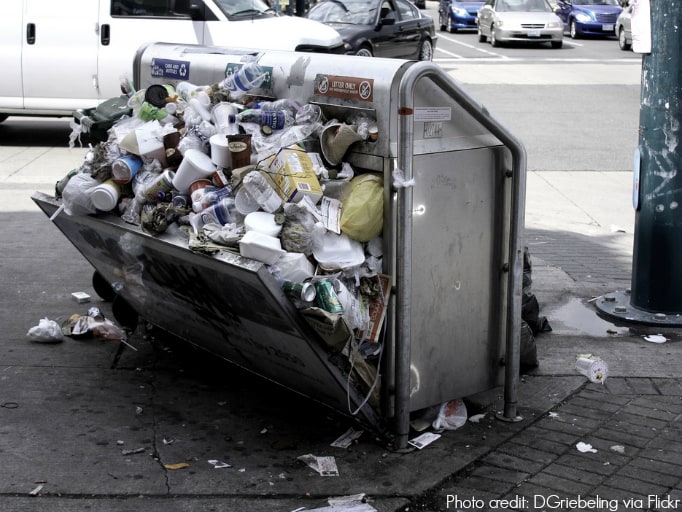
Open Trash by DGriebeling via Flickr

The goal is to attempt to produce zero waste for the week. Waste is anything that leaves the flat. This means rubbish (landfill) and recycling. Recycling is still waste, and we should all be trying to recycle as little as possible! Food waste given to the worms in the worm farm does not count as waste. In the interests of hygiene I can’t just refuse to empty my bin should it need emptying, so every day, starting from Monday, I’m going to record what (if anything) gets discarded. By Sunday I’ll have compiled a Wall of Shame with a list of all the things that I couldn’t deal with myself and had to dispose of…and that will give me some new goals to work towards!

It’s always nice to have company, and I’d love it if you joined me! I’ll be updating my progress on Facebook and Twitter, and if you want to give it a go I’d love you to share your stories too! Of course you can comment here as well, and if you just want to sit back and watch I’ll write another blog post once it’s over. But that would be boring!

What do you say? Want to give it a go? C’mon, it’ll be fun! Who’s with me?!

[leadpages_leadbox leadbox_id=1429a0746639c5] [/leadpages_leadbox]

https://treadingmyownpath.com/wp-content/uploads/2014/06/Bin-Noir-by-Jes-via-Flickr-800px.jpg 593 800 Lindsay (Treading My Own Path) https://treadingmyownpath.com/wp-content/uploads/2019/06/logo.png Lindsay (Treading My Own Path)2014-06-05 14:11:262017-09-01 15:47:59A Challenge: My (Upcoming) Zero Waste Week

Plastics and Health: Phthalates

3 Comments/in Health & Wellness, Plastic Free Living/by Lindsay (Treading My Own Path)

Plastic was the wonder product of the 1960s. Strong yet lightweight; durable yet inexpensive; plastics made everyday items affordable to the less well-off and revolutionized consumerism. The popularity of plastic means today it has become the manufacturing material of choice. After all, it’s so versatile. Plastics can be transparent, translucent, opaque; they can be coloured and patterned; they can be molded into any shape.

A true wonder product? Or not?

When something seems too good to be true, it usually is. Sadly, plastics are no exception. I’ve talked about the fact they last forever and the problems that come once their useful life is over (you can read about that here). But what about during their life?

It turns out that plastic isn’t the inert, safe material that was once thought. Chemicals added into plastic to instill specific properties can leach back out… and they’re entering our food, our water and our bodies. Plastic is affecting our health.

I’ve already talked about BPA, one of the additives used that has been found to leach from plastic – an additive linked to cancer and developmental problems in children. (You can read more about BPA here). Now I want to talk about another group of additives that have gained a lot of bad press: phthalates.

What are Phthalates?

Phthalates are a group of chemicals, sometimes called plasticizers, added to plastic to make them soft and malleable. They are a particularly common additive to PVC (plastic type #3). Without plasticisers, PVC is rigid (this is sometimes called uPVC, meaning unplasticised PVC, and is used for building materials and window frames).

Where are Phthalates found?

PVC is used for all kinds of products. If a plastic PVC product is flexible, unless the packaging states that it does not contain phthalates, the chances are that it does.

Plastic wrap (cling film/Glad wrap) is typically made out of PVC.

So are many children’s toys, clothing and school supplies, including lunchboxes and eating utensils, school bags, pencil cases, ring binders and folders, raincoats and umbrellas.

PVC is also found in households as furniture, flooring, shower curtains, wallpaper and electronics.

Baby products including sippy cups and bottles, squeezy toys and changing mats also contain phthalates, although since 1999 in Europe and 2009 in the US, some phthalates have been banned from baby and children’s products because of the negative health implications.

Not Just Plastic…

Phthalates are not just found in plastic. They are also found in many beauty products, including shampoo, lotions, perfumes, hair gel, nail polish and deodorant. They help make lotions feel smooth, mix better and increase absorption into the skin.

You may not see them on the labels either: the law permits them to be labelled as ”fragrance”.

Why are Phthalates bad?

Phthalates don’t actually chemically bind to the plastic they’re mixed with, meaning that phthalates are released from plastic products over time. This occurs more rapidly as a result of heat, exposure to solvents and friction.

Have you noticed how soft plastics get increasingly hard and brittle over time? That’s because the phthalates have leached out of them.

Some phthalates are particularly attracted to fats, and food products with a high fat content such as cheese, meat and other dairy wrapped in PVC film have been found to contain notably high levels of phthalates.

Phthalates enter our bodies via ingestion, but also inhalation and absorption through the skin. As well as being detected in blood, sweat and urine, they have been found in breast milk and are known the cross the placenta. We are widely exposed to phthalates because PVC is such a widely distributed material.

Children are more exposed because they spend time playing on floors, many children’s toys are made from PVC, and children are more likely to put plastic products in their mouths. This is compounded because they are much smaller than adults so the toxic loading increases.

Women are also more susceptible because of their use of beauty products containing phthalates.

Like BPA, phthalates are now known to be endocrine disruptors, meaning they mimic hormones in the body. Phthalates have been linked to increased obesity, liver damage, reproductive disorders, asthma and development issues in children. The phthalate DEHP has been classified as a “probable human carcinogen” by the US EPA, meaning it is likely to cause cancer. Studies have linked phthalates to breast cancer.

 How can I avoid Phthalates?

There’s plenty of things you can do to avoid exposure to phthalates. Here’s just a few ideas to get started:

1. Avoid PVC (plastic #3, also sometimes written as V within the recycling arrow). If you need to buy products made of plastic, look for plastics #1, #2 and #5 as these are considered “safer” plastics. Or skip the plastic altogether. Choose products made from wood, metal, glass or natural fibres.

2. Don’t use plastic wrap! Whilst safer alternatives that are phthalate-free do now exist, how long before these safer ingredneits are exposed to be hazardous too? Plastic wrap is really unneccessary. Store food in tins, jars, in glass or pyrex, or simply in a bowl with a plate on top.Try not to buy cheese or meat that’s been wrapped in PVC film either – take your own container, ask for it to be wrapped in paper or look for non-PVC plastic packaging.

3. Choose safe cosmetics. Look for certified organic products; a product that says “contains natural/organic ingredients” may still contain many chemicals. Choose products with fewer ingredients, preferably ones that you have heard of! Seek out products fragranced only with essential oils. Find local producers that make small batches using natural ingredients; you can speak to them about exactly what does and doesn’t go into their products. If you want to know how safe the products you are already using are, check out the Environmental Working Group’s Skin Deep database of over 68,000 products. Question whether there’s any products you use that you could actually do without. Simplify.

4. Look for phthalate-free children’s toys and clothes, and remember if buying second-hand that phthalates were not banned before 2009, so older products may still contain these chemicals. Be particularly wary of school supplies. Anything shiny, glossy and waterproof is probably made of PVC.

5. Eat organic. Phthalates are found in pesticides, and also in sewage sludge (remember phthalates are found in urine). Organic farms are not permitted to use either of these and so organic crops are less exposed to phthalates than conventional crops.

[leadpages_leadbox leadbox_id=1429a0746639c5] [/leadpages_leadbox]
https://treadingmyownpath.com/wp-content/uploads/2014/04/Plastic-Phthalates-Treading-My-Own-Path.jpg 666 1000 Lindsay (Treading My Own Path) https://treadingmyownpath.com/wp-content/uploads/2019/06/logo.png Lindsay (Treading My Own Path)2014-04-14 14:27:202017-09-01 15:22:31Plastics and Health: Phthalates

Plastic Shores: a Movie Review

0 Comments/in Plastic Free Living/by Lindsay (Treading My Own Path)

Last Friday I saw the eco documentary Plastic Shores at the delightful Ecoburbia monthly movie night. The Producer/Director Edward Scott-Clarke describes the movie like this:

‘Plastic Shores’ is a documentary that explores how plastic affects the marine environment. Travelling from the International Marine Debris Conference in Hawai’i to the polluted Blue Flag beaches of Cornwall, the film reveals just how bad the problem of plastic debris is and how it harms aquatic life and, potentially, human health. 300 million tonnes of plastic are produced in the world every year and a third of this is for disposable packaging. There is now, according to the UN, not a single beach or sea in the world that is not affected by plastic pollution and the problem is only increasing.

Here’s the trailer:

Now you know me, I love a good eco documentary, especially one about plastic. I love Bag It!, and also The Clean Bin Project (not specifically about plastic but waste in general, and an excellent documentary), so I was looking forward to this.

I have to say, I found it somewhat disappointing. It opened with an interview, and the interviewee was extolling the virtues of plastic, and this wasn’t really countered by the film’s narrator. The interviewee actually made some good points, including that transporting plastic is lighter than glass (reducing fossil fuel use and emissions), and that if plastic was replaced with other materials, there would be far greater burden on the planet in terms of mining and cost.

I was expecting the movie to then counter these arguments, perhaps with a mention of the need to cut back on consumption in general, the fact that whilst plastic has some great uses, a lot of plastic is for single-use items, or that plastic is made from fossil fuels, maybe even that despite the benefits, the ultimate environmental cost outweighs all the advantages.

But there was no response at all. It seemed a strange way to introduce the movie, leaving viewers confused as to the message the film was trying to get across.

The content itself was informative, although a little slow moving. There were facts revealed that I didn’t know (apparently 5% of oil production is used for plastic manufacture), and the issue of plastic pollution in the oceans was very clearly explained. There was a lot of detail of how plastic has affected Hawai’i, and interviews with some knowledgeable and informed plastic activists.

What disappointed me most, though, was the solutions, presented after all the negative impacts of plastic on the oceans had been covered. I guess I was just expecting more.

‘Reduce’, was the first option; the solution? Take your own bags to the shops. I felt that most people who would take the time to watch this (any?) eco-documentary were probably past the whole ‘bring-your-own-bags’ scenario. This was discussed in great detail, including interviewing a man who ran a company making biodegradable bags… from fossil fuels. Hardly a win-win solution.

No other solutions were really discussed; the movie moved on to ‘Re-use’. There was a sweeping statement that all plastic is reusable, combined with camera shots of used syringes, empty crisp packets and condom wrappers. I would think that the issue with most single-use plastic is that, actually, it is not reusable. Surely that is the point?

Then we were back to the trusty ‘Recycle’. “We should recycle what we can”, the movie tells us. Again, most people taking the time to watch an eco documentary are probably already at this point.

I just felt that there was so much more to say. There was no discussion about the impact of convenience, of how convenience is a key generator of waste and a huge part of the plastic problem. There was no real discussion about reusable containers, cutlery, water bottles, refusing straws, avoiding single-wrapped items, yet there was so much potential.

I felt this was a missed opportunity.

The biggest let down, for me, was that this movie did not inspire. It educated, yes, but I didn’t leave feeling like I could make a difference, or armed with any new tips, or empowered to make changes. That’s exactly what I love about Bag It and the Clean Bin Project. They show what ordinary people can do (and are doing) to make a difference. For me, that is the key to a successful eco documentary. It should empower.

Oh, and there should be some light-hearted moments, some humour, some fun. It’s not all doom and gloom, and making people feel like it’s all too much does not inspire change.

If you’re a die-hard zero waste advocate, then watch it; you’ll probably still learn something new. If you’re not, I’d give it a miss. Bag It! and Clean Bin Project have a similar message but are uplifting, fun, and more enjoyable to watch.

Have you seen Plastic Shores? What did you think? Do you agree with me that a good eco documentary should be inspiring? Maybe you’re a fan of the ‘Doom and Gloom’ approach? I’d love to hear your thoughts!

[leadpages_leadbox leadbox_id=1429a0746639c5] [/leadpages_leadbox]

https://treadingmyownpath.com/wp-content/uploads/2014/04/Plastic-Movie-Screening-Treading-My-Own-Path.jpg 666 1000 Lindsay (Treading My Own Path) https://treadingmyownpath.com/wp-content/uploads/2019/06/logo.png Lindsay (Treading My Own Path)2014-04-10 11:45:462017-09-01 15:21:59Plastic Shores: a Movie Review

Make Your Own: Plastic-free, Sugar-free Muesli

17 Comments/in Plastic Free Living, Recipes, Zero Waste/by Lindsay (Treading My Own Path)

I used to be a huge lover of breakfast cereals. I’d hoard them. I actually had a cupboard dedicated to breakfast cereal. I liked to have a minimum of 5 different choices in my cupboard, and I remember once having 11 different types on the go. I’m not the only one either, it seems. In 2011 Australians spent $1.17 billion on breakfast cereal, and consumed almost 8 kilos per person!

My tastes changed over time of course – as a kid I loved Frosties (I cringe at that thought now), as a teenager my staple cereal was Fruit ‘n’ Fibre, and as an adult I fell for those luxury muesli lines with the beautiful packaging.

But then I began to fall out of love with cereals. Firstly there was the media reports revealing how cereals are way too high in salt and sugar. Low fat cereals are particularly high in sugar, and a UK study found cornflakes that contained as much salt as ready-salted crisps. Next was the constant bombardment of adverts and marketing. Oh we’ve made this new product. Oh we’ve made that new product. Oh we’ve made a chocolate version! A cereal bar version! A chocolate cereal bar version! I started getting cereal company fatigue. And then there was the packaging. Boxes that would appear enormous until I opened them to find the contents only half-filled the bag inside. Or packets that would declare “contain 20 servings”, only for me to discover that their interpretation of a serving was 4 teaspoons, and for my portions, the box contained nearer to four servings. Which actually made cereal a rather expensive habit.

And the final straw? Plastic. When I gave up buying anything in plastic, only a couple of options remained. Some super fancy muesli sold in glass jars for exorbitant prices, or plain oats in cardboard. The love affair was over.

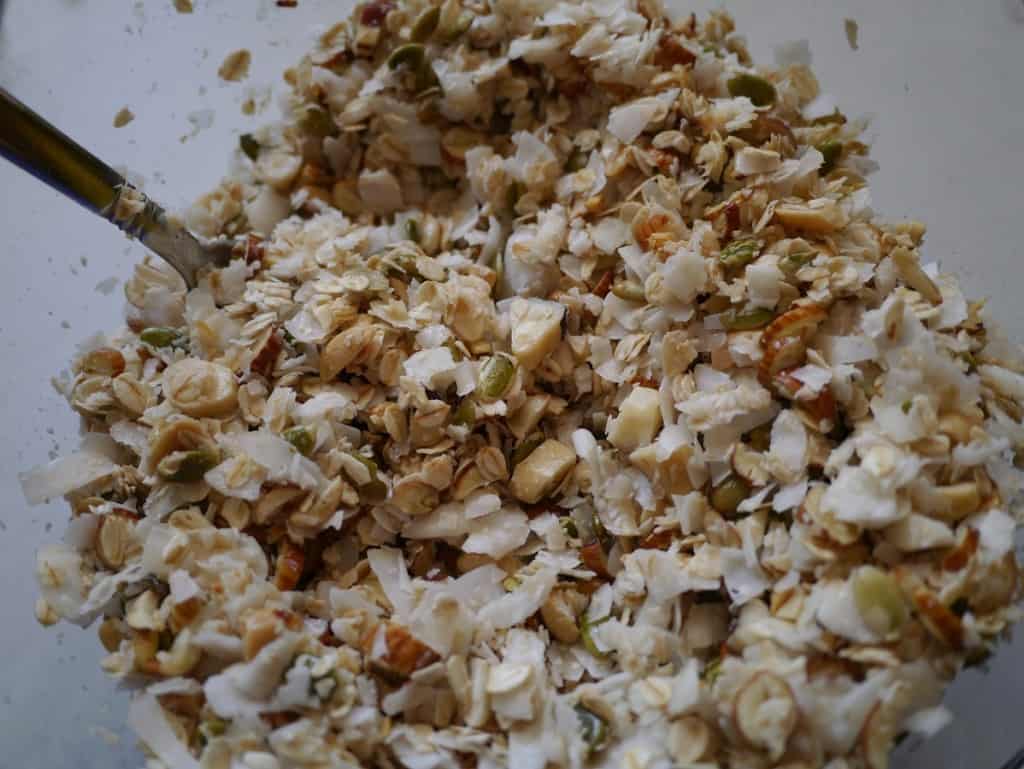
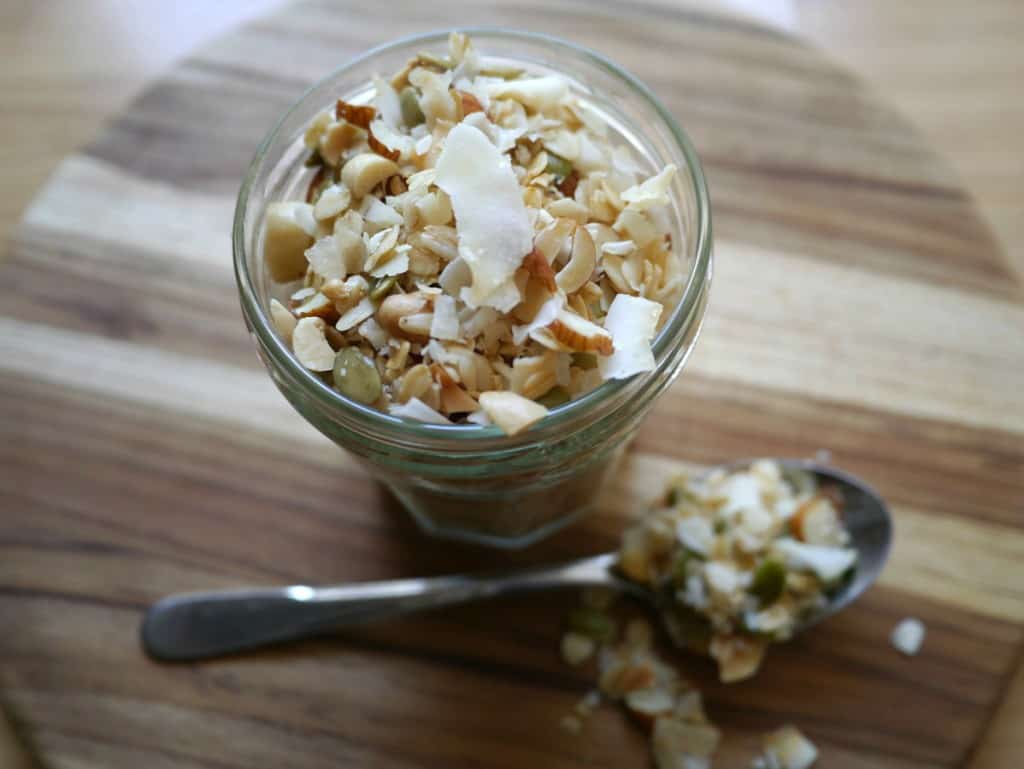
But recently, I’ve started craving cereal again, and so I’ve started making my own using the ingredients I get from the bulk-bin stores. It’s super easy and there are limitless possibilities. This recipe is my current base.

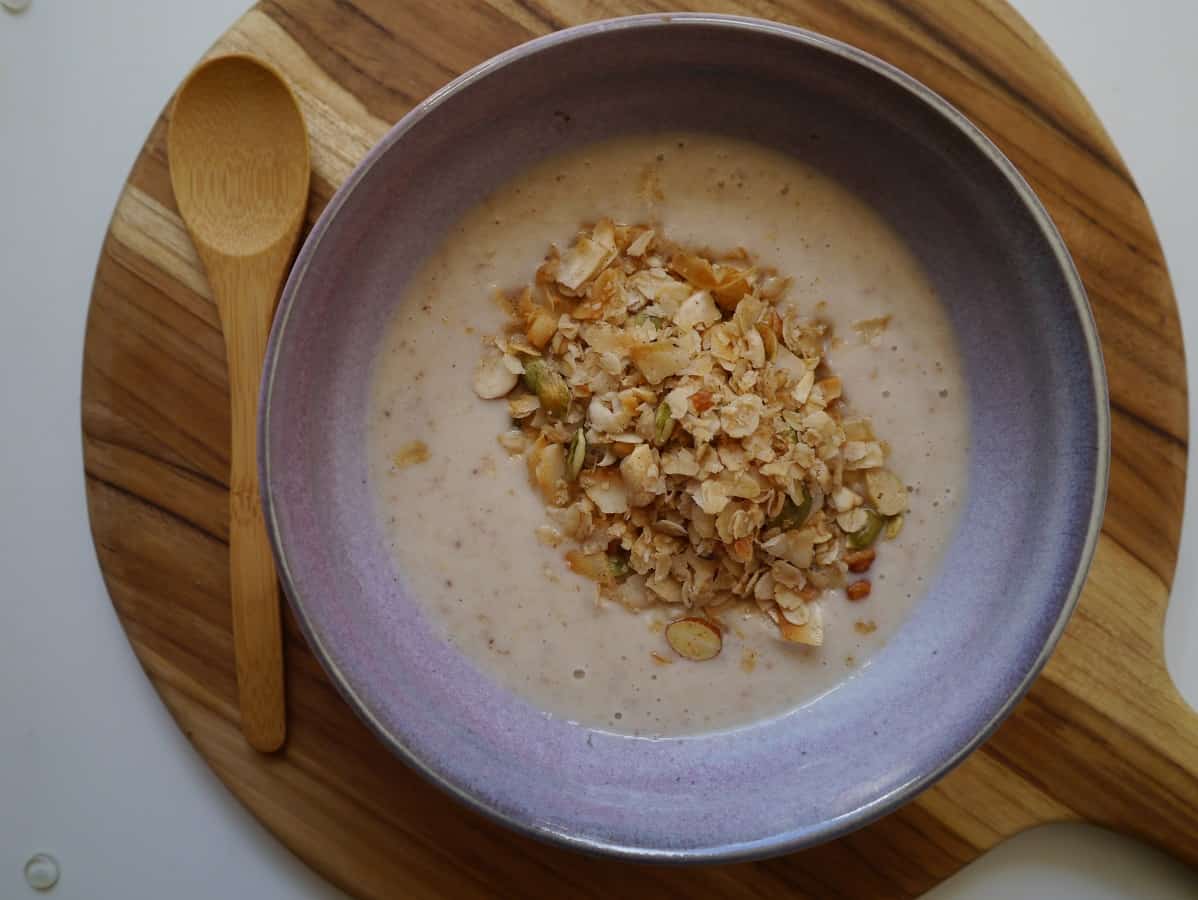
I wanted to keep it sugar-free so it doesn’t contain any dried fruit. If one morning I fancy something sweet I add some fresh fruit, or blend a banana with some (cashew) milk and sprinkle the muesli on top.

Or I add a teaspoon of bee pollen or a tablespoon of cacao nibs. You can always add the sugar in, but you can’t take it out!

Recipe: plastic-free, sugar-free muesli

Ingredients:

3 cups coconut flakes
2 cups oats
1/2 cup brazil nuts
1/2 cup peanuts
1/2 cup raw almonds
1/2 cup pumpkin seeds/pepitas
80ml macadamia oil (or other high quality, flavourless oil)

Method:

[I soak my almonds and pumpkin seeds overnight to activate them and make them more digestible, and then dry them out before chopping and adding to the mix. If you can’t be bothered with this step or are short of time, just skip it.]

Roughly chop the brazil nuts, peanuts and almonds. Combine in a bowl with the coconut flakes and oats. Stir in the oil and mix well until everything is well coated.

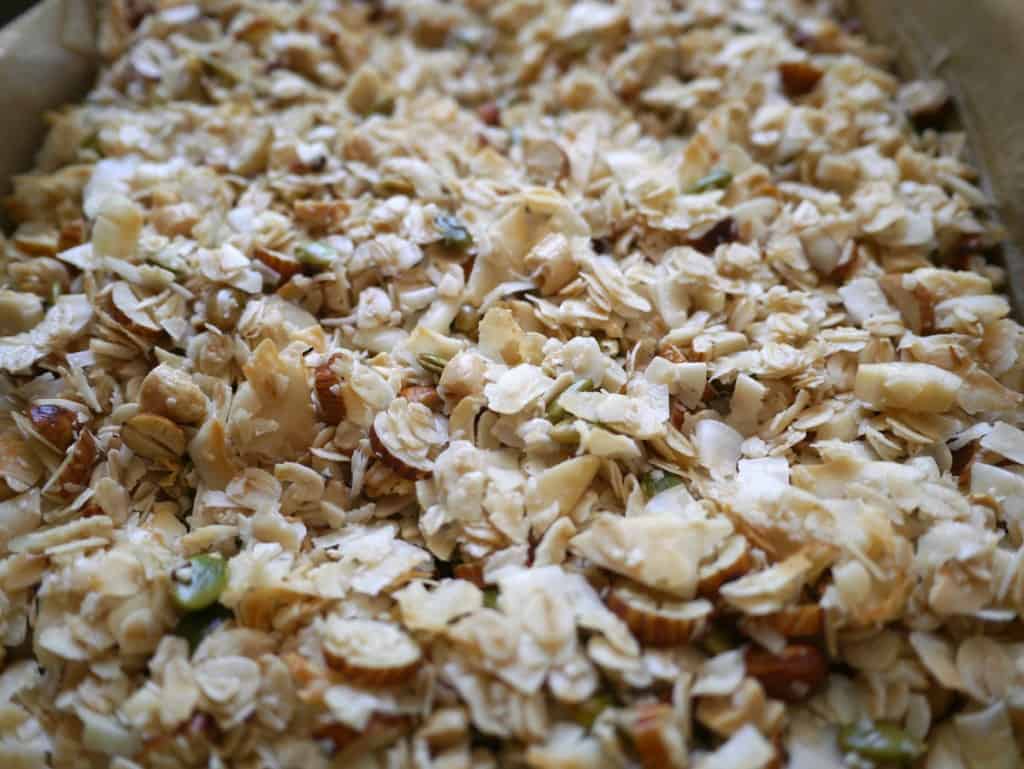
Line a baking tin with baking paper. Spread the mixture evenly over the paper and bake at 100ºC for 30 minutes, until golden. Leave to cool.

Store in a glass jar. It will keep for a few weeks, but I think it is better to make small batches and more often to keep it fresh.

Enjoy!

mueslimix

muesli4

mueslijar

05_03breakfast

This delicious breakfast was made using half a banana blended with half a cup of cashew nut milk to form the base, and topped with half a cup of muesli. I like doing things by halves, it seems!

[leadpages_leadbox leadbox_id=1429a0746639c5] [/leadpages_leadbox]

https://treadingmyownpath.com/wp-content/uploads/2014/03/muesli.jpg 900 1206 Lindsay (Treading My Own Path) https://treadingmyownpath.com/wp-content/uploads/2019/06/logo.png Lindsay (Treading My Own Path)2014-04-04 08:00:312019-12-23 09:23:23Make Your Own: Plastic-free, Sugar-free Muesli

BPA: what it is and why we should avoid it

7 Comments/in Health & Wellness, Plastic Free Living/by Lindsay (Treading My Own Path)

BPA, an additive found in plastic and tins used for food storage, has had a lot of bad press. If you have heard of it, you’ve probably heard that you should try to avoid it, even if you’re not quite sure why. Here I tell you what it is, why you should avoid it, and why shopping for  plastic that’s labelled “BPA-free” might not be the safe option that you think it is…

What is BPA?

BPA is short for bisphenol A, with the chemical formula (CH3)2C(C6H4OH)2 (more on this later). It is a chemical additive used in some types of plastic, particularly polycarbonate plastic and epoxy resins. According to Wikipedia, it has been used commercially since 1957.

Where is BPA found?

Polycarbonate plastic is the hard-wearing, scratch resistant, transparent plastic that has many uses including as food storage containers, water bottles and baby sippy cups. Epoxy resins are coatings that are used in food and drink cans to line them. There are 131 million food and beverage cans made in the USA alone every year, and most will be lined with epoxy resins containing BPA.

polycarbonate

You can check if your food containers are made from polycarbonate – they will be labelled as plastic #7.

moreBPAtins

Tins are often lined with epoxy resins that contain BPA.

Why is BPA bad?

Hormones in our body are responsible for maintaining normal cell metabolism. This hormone system is called our endocrine system. Synthetic hormones can disrupt the natural processes that occur. BPA has been found to be a synthetic hormone (also known as an endocrine disruptor). Endocrine disruptors interfere with the synthesis, secretion, transport, binding, action, or elimination of natural hormones in the body which are responsible for development, behaviour, fertility, and maintenance of normal cell metabolism.

BPA mimics the female hormone oestrogen. This has been linked to a number of side effects including increased risk of heart disease, diabetes and liver-enzyme abnormalities; brain and hormone development problems in small children; increasing cancer cell growth rates, particularly breast cancer; and sexual problems in men.

Some countries have already taken steps to ban BPA. In June 2011, the EU banned the sale of baby bottles containing BPA. Canada actually banned BPA in baby bottles in 2009. In 2012 France voted to ban the trading, marketing and promoting of all food containers containing BPA, with the ban for childrens’ products coming into effect in January 2013, and for all other containers in 2015.

Many other governments and advisory committees are still debating whether BPA should be banned completely. That there is any debate at all highlights that there is obviously some level of concern, and if the governments won’t do the right thing, we should do what we can to reduce our own exposure to BPA.

How much risk is there?

In 2011, the Harvard School of Public Health found that volunteers who ate canned soup for 5 days had 1000 times the concentration of urinary BPA compared with when they ate fresh soup.

Research shows that most exposure to BPA occurs from the diet. That means we’re eating it. So how is it getting from our containers into us?

  • BPA can leach from cans where an epoxy resin has been used, ironically, to protect the food contents from direct contact with the can.
  • BPA leaches from plastic containers when they contain acidic or high-temperatures foods.
  • Harsh cleaners have also been demonstrated to release BPA from polycarbonate containers, as does exposing them to high temperatures – including dishwashers and microwaves.

Have you ever put leftovers into a plastic container, and when you’ve emptied it out later you’ve noticed that the food appears to have stained the container? If our food can stain the plastic, then the chemicals in the plastic can stain our food. 

How can I tell if my containers are made with BPA?

Often plastics have numbers printed on the bottom of them to aid with classification (if you want to know a little bit more about what these numbers mean, read this helpful guide). Typically polycarbonate containers are described as “other” or #7, or PC. It is extremely likely that these types of plastic contain BPA. Some plastics that are labelled #3 may also contain BPA. But often food storage containers don’t contain any numbers or labelling, in which case you just don’t know.

But my brand new polycarbonate plastic containers said “BPA-free”! Surely they are safe?

BPAfree

These containers claim to be BPA-free, but is there a catch?

You’d think so, wouldn’t you? But companies are very clever. They are aware of the public distrust of BPA, and they want to continue to sell their plastic products. They need a way to convince us that their products are safe.

However, they also need additives to make their properties hard-wearing, transparent and heat-resistant, just like BPA would do. If they can’t use BPA, then they need another alternative.

Hello, BPS.

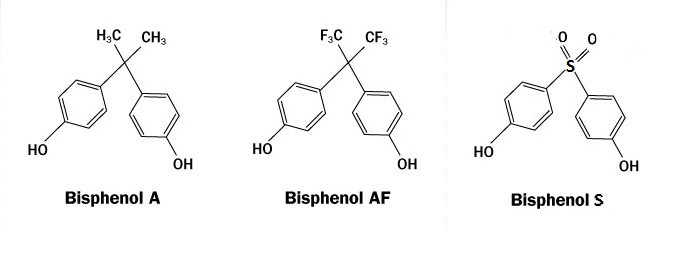
BPS, or bisphenol S, is a plasticising agent that has become increasingly common since BPA got all the bad press. The chemical structure of BPS is remarkably similar to that of BPA – and it turns out it it also acts as a synthetic oestrogen and endocrine disruptor.

And what about BPAF, or bisphenol AF?

BisphenolStructure

The chemistry of BPA and its alternatives

Remarkably similar, don’t you think? The main advantage of using these alternative chemicals is that they get round any bans on BPA products, and allow such products to be labelled BPA-free.

There is no requirement for companies to tell consumers what additives, fillers, dyes, flame retardants, plasticisers, additives, antibacterials, perfumes have been added to plastic products. When it comes to food storage, the safest thing is to avoid plastic altogether.

What are the alternatives?

Here’s my three top tips for avoiding BPA in your food.

1. Cut back on cans.

It’s almost impossible to tell if a can contains BPA until you’ve opened it, and even cans labelled as BPA-free may have other unsavoury additives, so where possible, avoid cans and choose alternatives.

2. Stop using plastic containers for food storage.

That doesn’t mean throwing them away, just re-purposing them for non-food storage.Glass and stainless steel are much safer alternatives for food.

glassandstainlesssteel

Glass and stainless steel are great, non-reactive materials to use for food storage

If you can’t afford to (or don’t want to) splash out on a whole new storage set, try finding second hand items from your local charity shops, or reuse old glass jars – you can even use them in the freezer. Ceramic and pottery dishes are great choices too, although they might not be suitable for freezing.

3. Don’t microwave plastic!

Where you have no alternative but to use plastic, make sure you don’t put it in the microwave or heat it up in any other way (so don’t put it in the dishwasher either), as this destabilises it and causes BPA to leach into your food. If you use a plastic lunchbox, empty the contents into a ceramic or glass bowl and pop a plate on top before microwaving, or if you can, use a saucepan.

Plastic manufacturers are not required to disclose which additives are added to their plastic products, and additives are not currently tested for health implications. Until they are, we should not assume any plastics are safe. After all, BPA has been used since the 1950s, and it is only in the last few years that it has been recognised as unsafe. Plus, there’s really no need to use plastic when so many other great alternatives exist!

[leadpages_leadbox leadbox_id=1429a0746639c5] [/leadpages_leadbox]
https://treadingmyownpath.com/wp-content/uploads/2014/03/Science-Plastic-and-Health-BPA-Treading-My-Own-Path.jpg 667 1000 Lindsay (Treading My Own Path) https://treadingmyownpath.com/wp-content/uploads/2019/06/logo.png Lindsay (Treading My Own Path)2014-03-31 12:00:202017-09-01 15:19:24BPA: what it is and why we should avoid it

Another step in the right direction

9 Comments/in Plastic Free Living/by Lindsay (Treading My Own Path)

The parcel I’ve been waiting for all week finally arrived on Friday. Oh the excitement! I don’t order things online much anymore, but it wasn’t the idea of receiving a parcel that caused my excitement. It was the contents of the parcel…

Toilet paper.

Yes. You did read that right. Read more

https://treadingmyownpath.com/wp-content/uploads/2019/06/logo.png 0 0 Lindsay (Treading My Own Path) https://treadingmyownpath.com/wp-content/uploads/2019/06/logo.png Lindsay (Treading My Own Path)2014-02-03 18:04:572014-02-23 20:52:57Another step in the right direction

Going Plastic-Free in Asia (Part Two – all the other plastic)

11 Comments/in Living With Less Waste, Plastic Free Living/by Lindsay (Treading My Own Path)

My goal was to travel around Thailand for four weeks without consuming any single use plastic. It’s what I do at home, so why should anything be different whilst I was away? I’ve already talked about how I avoided using disposable water bottles, which I thought would be the biggest battle. But there were other contenders.

The plastic straw

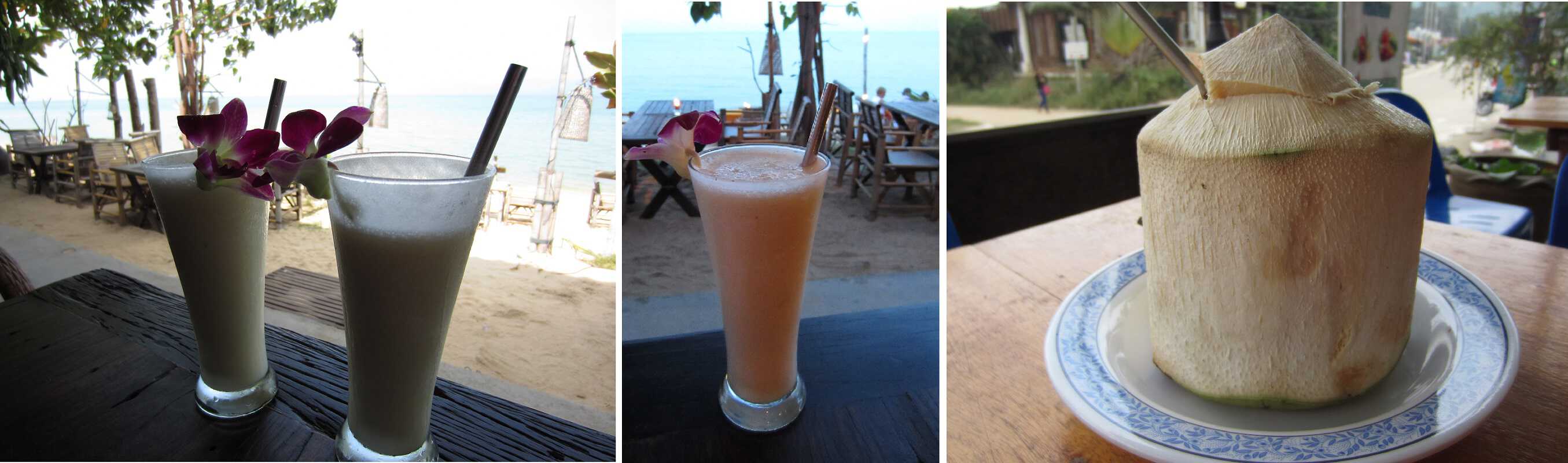
Thai people love straws. I thought the straw problem was bad in Australia, but there is a whole other level of straw-dependence over there. Every single drink seems to come with a straw. Of course the obvious smoothies and cocktails come with plastic straws. But less obvious drinks come with them too. If you buy bottled water to take away, it comes in a plastic bag and with a straw. If you buy a tin of fizzy pop, a straw is neatly tucked under the ring pull. Even tins of iced coffee and beer come with straws. It seems that the cultural norm is to drink your drink with a straw. Everyone does it.

Except, we didn’t want to use plastic straws.

I don’t know how to say “please don’t give me a plastic straw” in Thai. Fortunately, this didn’t matter, because I’d brought a stainless steel reusable straw with me from home. It was the single most used item on the trip. Whenever I purchased a drink, I’d whip out my straw and demonstrate that I had one, and no straw would come with the drink. I’m sure they all thought I was a crazy Westerner, but at least I was keeping to the local custom!

There were a couple of occasions where the staff forgot (there were two times that I can remember) and brought me a straw. I handed them back immediately unused, hoping that the straws would be washed and reused, but of course, they went in the bin. So usually I’d watch as staff prepared my drink, and if I saw any hands heading near the straws I’d run over, flailing my arms in the air until they panicked and handed the straw-free beverage over. I may have looked mad, but it worked.

straws

Our stainless steel straws in all their glory!

The plastic bag

The plastic bag is the other obvious contender, and you’d be forgiven for thinking it would be pretty easy to avoid these. Just say no when you buy something, right? But there were a couple of complications.

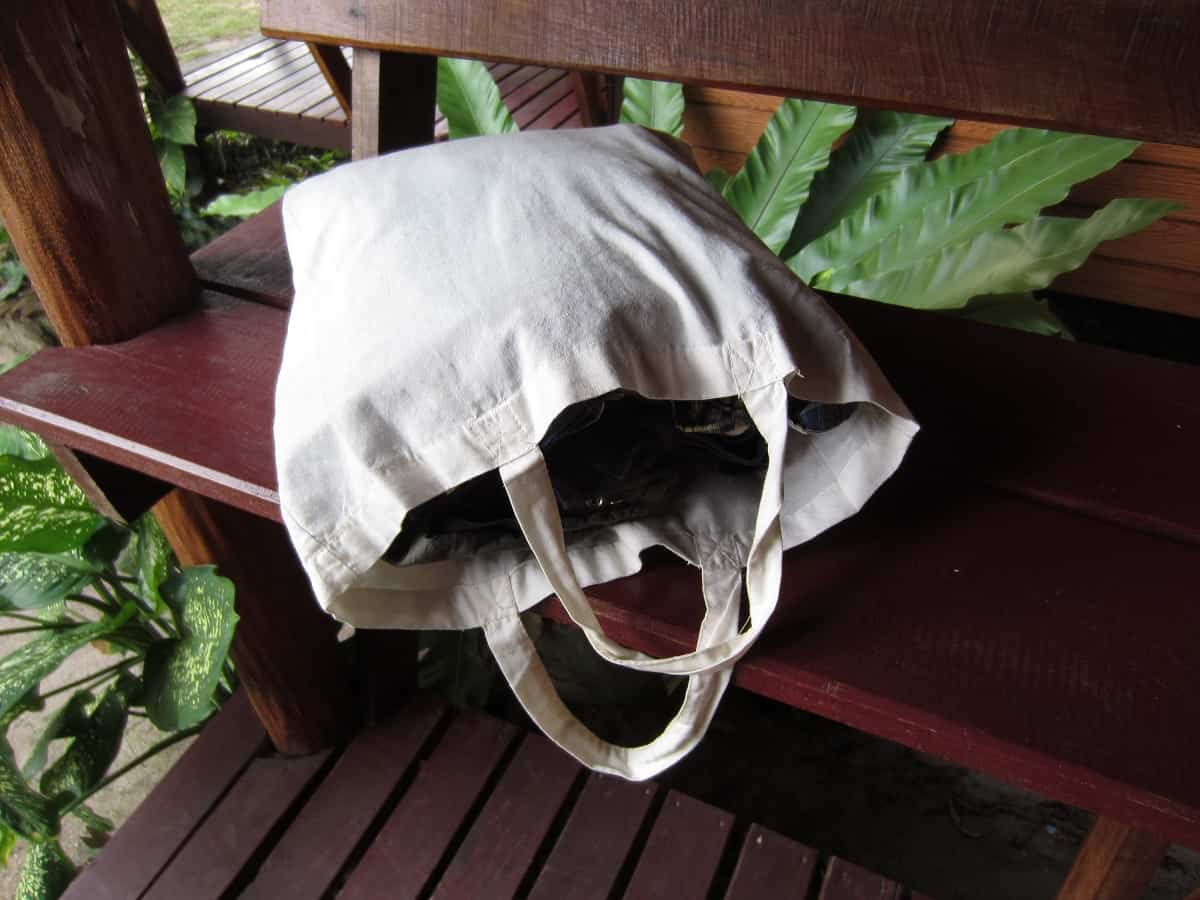
The first was laundry. In Thailand self-serve laundromats aren’t very common, and instead people offer a private laundry service where you pay by weight. You drop your laundry off and pick it up 24 hours later, smelling fragrant, neatly pressed… and folded in a plastic bag. It’s not like we could not use a bag altogether, because we’d have ended up dropping our underpants and socks all the way down the street. Fortunately we had brought a calico bag with us and we were able to use this instead.

laundry

Our freshly washed, neatly pressed laundry in the calico bag I’d brought with us. Plastic free!

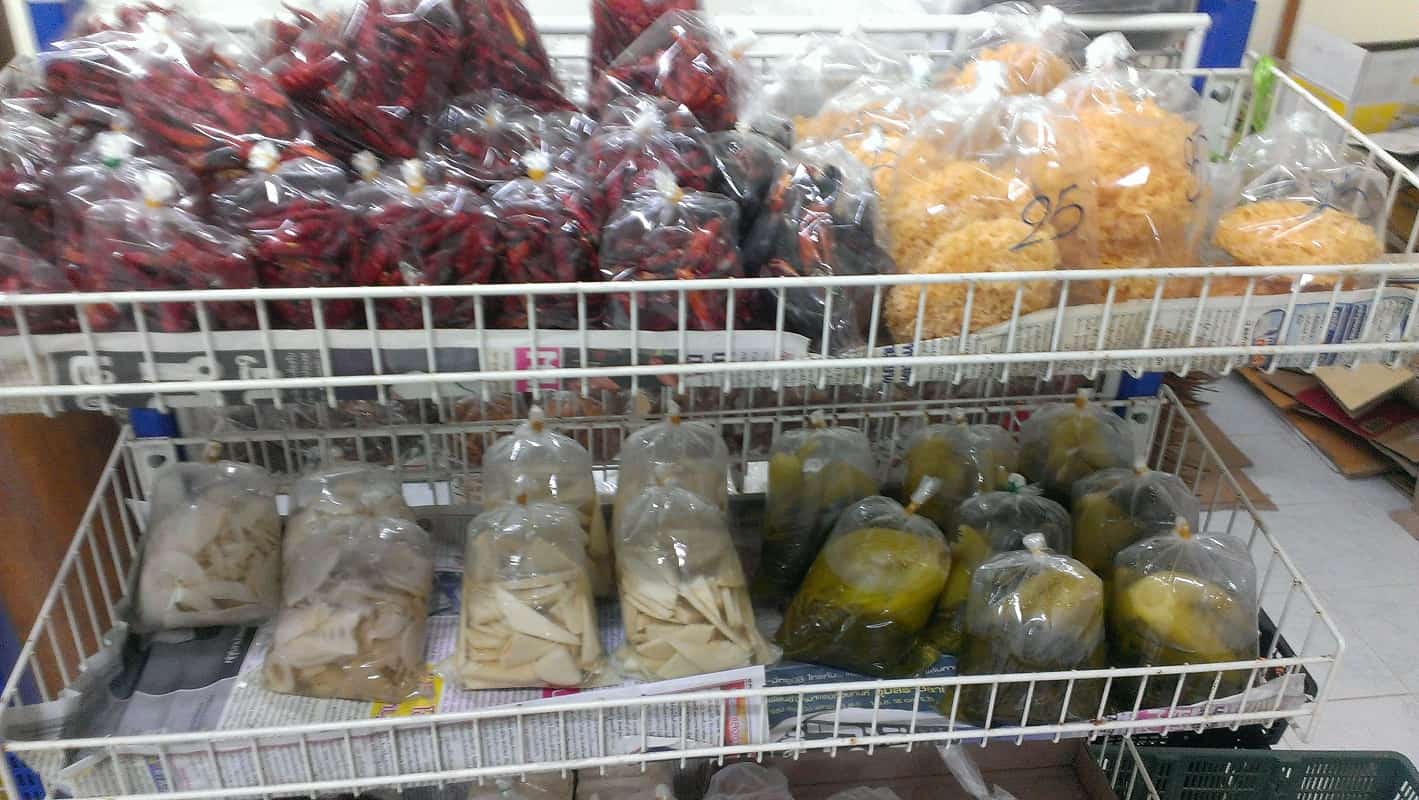
The second was that Thai people used plastic bags as a vessel for food and drink. Literally. They pour cold drinks, hot soups, curry, sauces, coconut milk, you name it, into plastic bags, seal them up, and send you on your way.

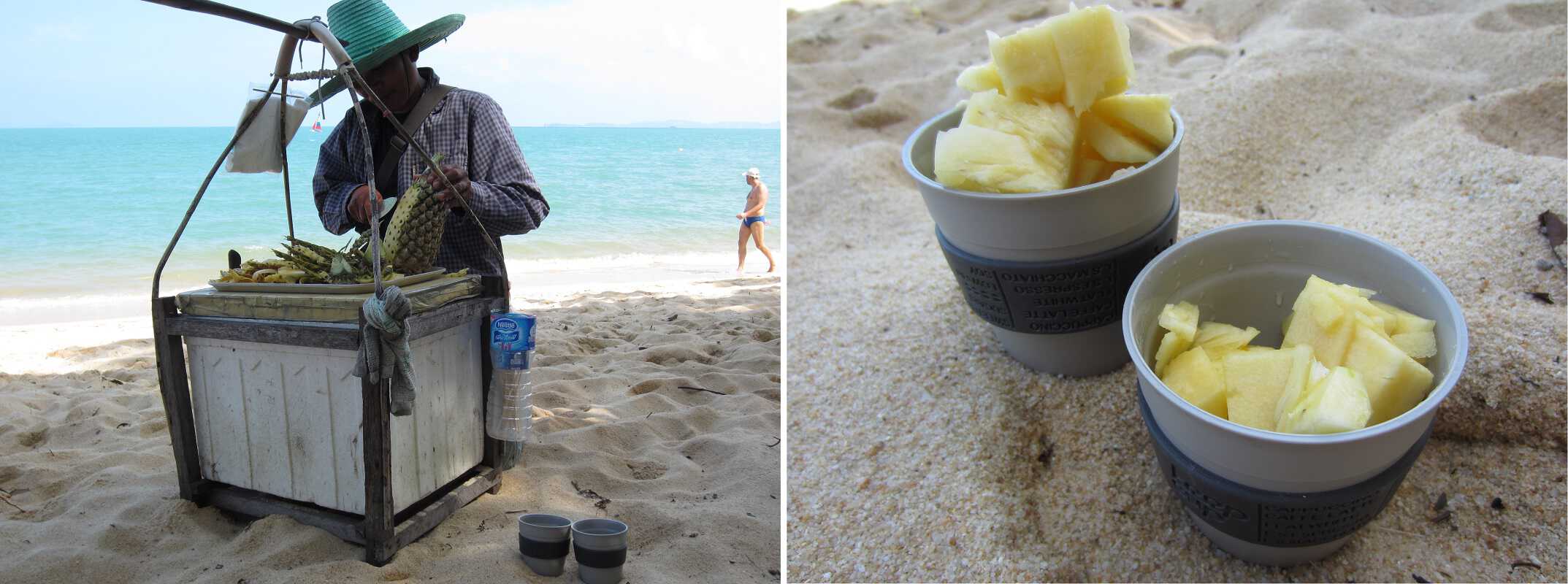
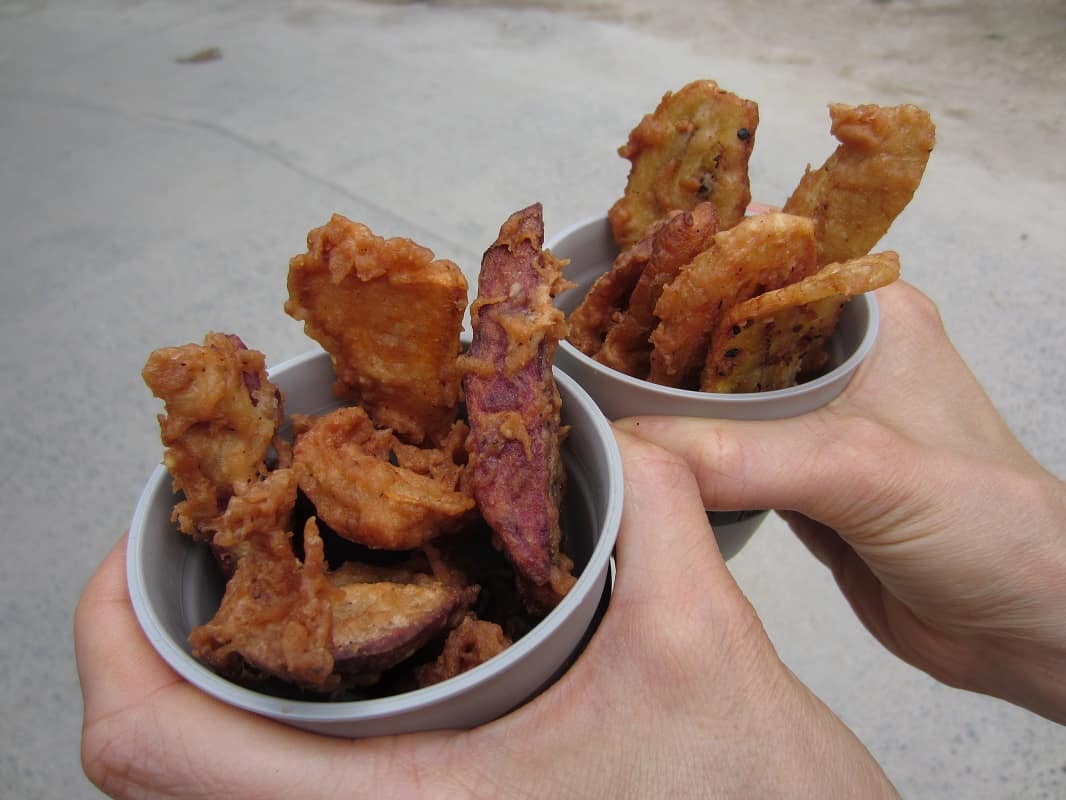
plasticbagsThere’s no way I’d want to eat or drink anything served that’s been transported and stored in a plastic bag, even if I hadn’t given up plastic. Fortunately, our KeepCups served as containers for food, so the few times we bought something as takeaway, we didn’t need to use plastic bags.

deepfried

Battered, deep-fried sweet potato and banana – so delicious! We used our KeepCups rather than any disposable packaging.

The most important place to avoid plastic is at the beach. There are no bins so the options for rubbish disposal are taking it home, leaving it there or burying it. Of course, with the last two, it’s only a matter of time before it gets washed out to sea. Best to avoid disposable plastic altogether!

pineapple

Other Disposables

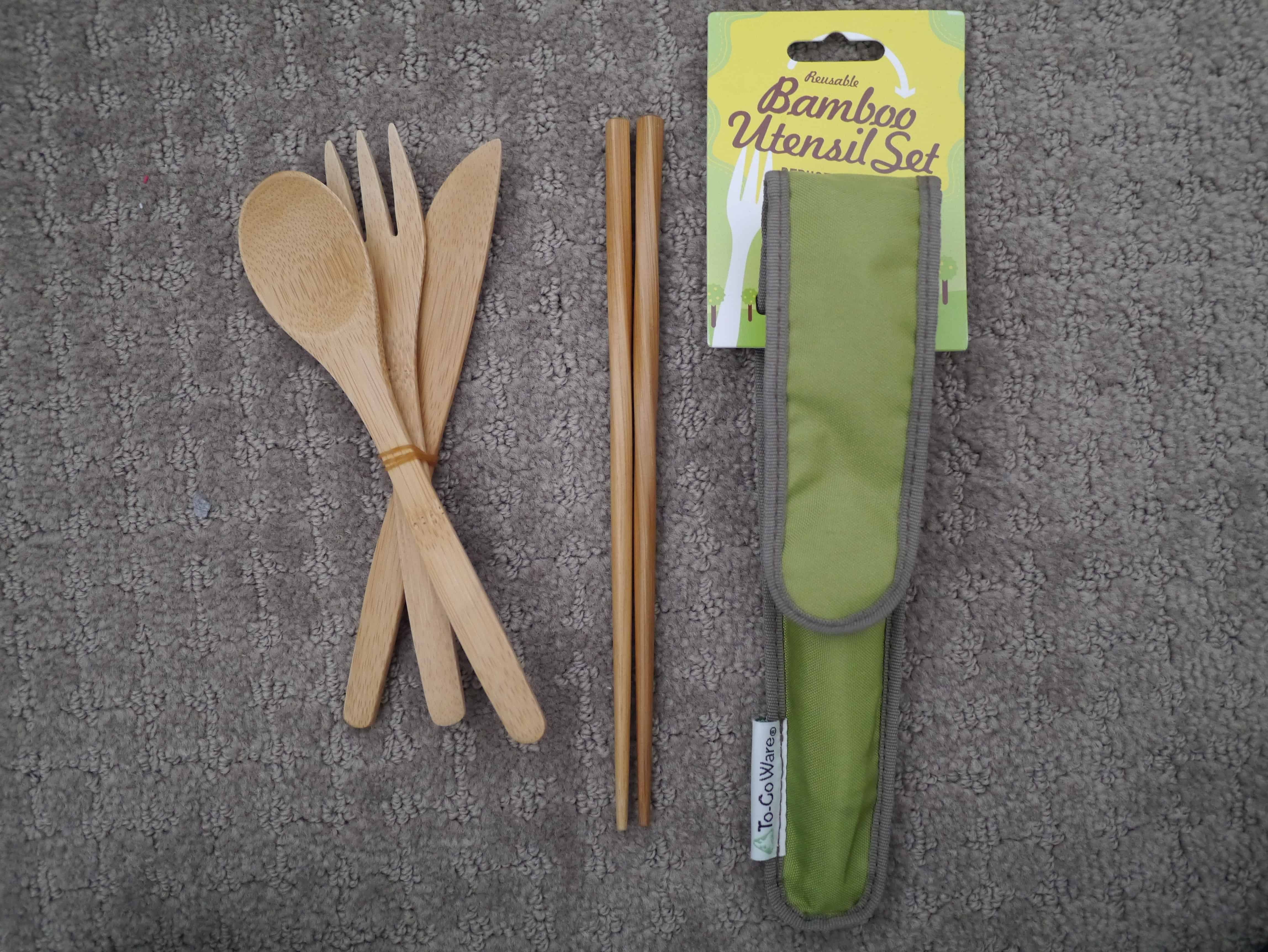
The main other disposable plastics that we were faced with were styrofoam trays (for takeaway food items) and plastic cutlery (for takeaway food items). We avoided using plastic cutlery by taking our own re-usable bamboo cutlery. The spoon was useful for ice cream and getting all the tasty coconut meat out of the drinking coconuts once they were empty, and I even managed to skin and chop up a whole mango with the knife!

cutleryAs for styrofoam, and any disposable food packaging, we avoided this by choosing to dine in rather than get takeaway. The food was fresher, we got to sit down and use metal cutlery and it looked so much more appetizing on a plate rather than stuffed in a plastic bag or cling-wrapped in styrofoam.

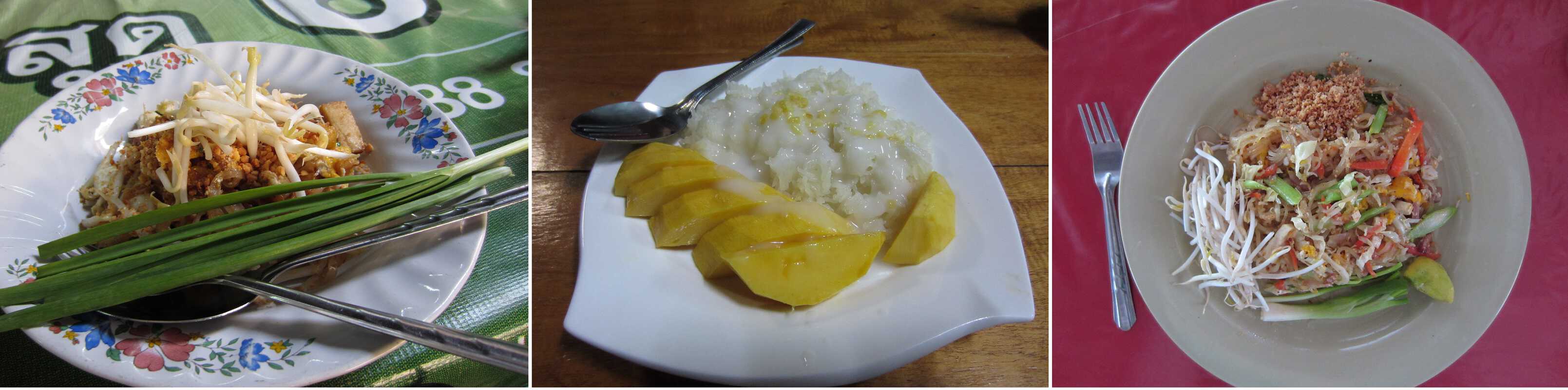
food

Imagine eating any of these out of a plastic bag… and yes the option was available!

Tips for Keeping Plastic-Free

There was a lot of plastic to avoid as so much stuff was packaged this way, but keeping plastic-free didn’t mean going without, it just meant looking a little bit harder for what we wanted.

I took a reusable straw, a reusable cutlery set, a KeepCup (which is a coffee cup with a lid that can double up as a small container), a cloth bag and my water bottle. All of these were invaluable. The only additional thing I’d take if I went back is a small sealable plastic container (Tupperware or similar), because the KeepCups were a little too small for most food.

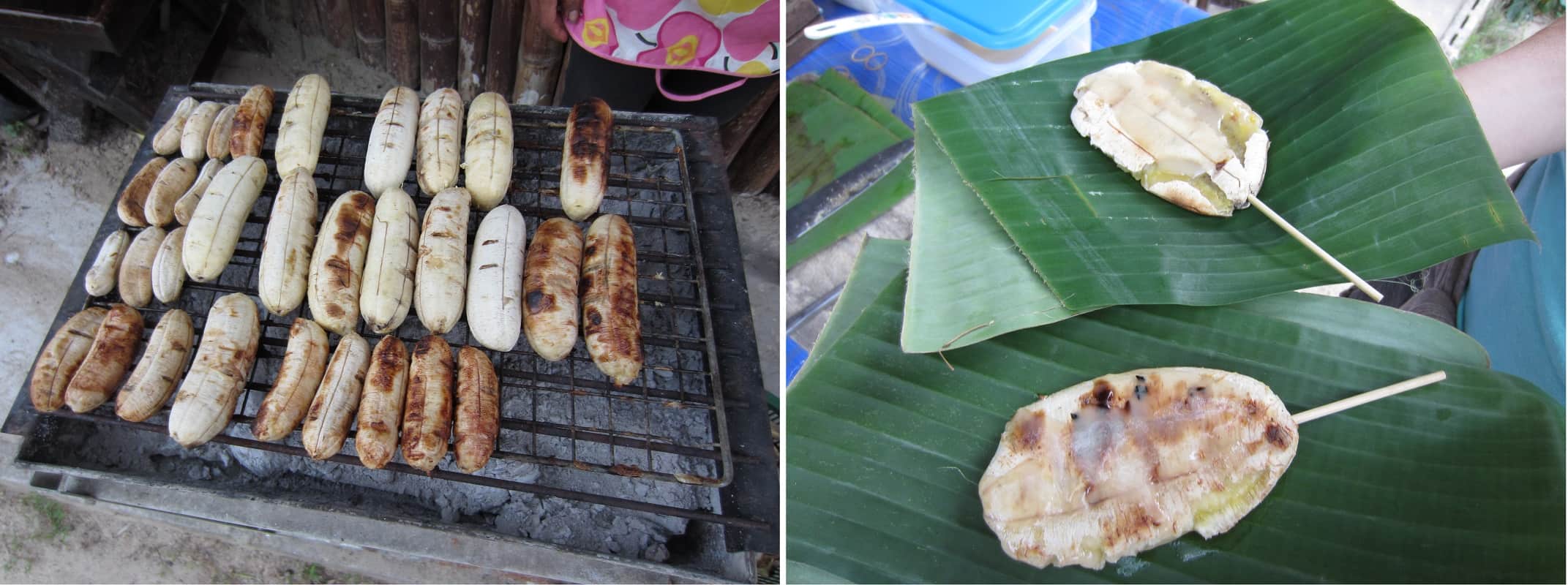
bananasAmongst all the plastic out there, there were plastic-free options, which were exciting to find! These bananas were barbequed, pressed and smothered in coconut sauce, and then served on banana leaves. Plastic-free definitely makes things taste more delicious!

[leadpages_leadbox leadbox_id=1429a0746639c5] [/leadpages_leadbox]
https://treadingmyownpath.com/wp-content/uploads/2014/01/pineapple.jpg 800 2147 Lindsay (Treading My Own Path) https://treadingmyownpath.com/wp-content/uploads/2019/06/logo.png Lindsay (Treading My Own Path)2014-01-10 13:06:102017-05-12 21:32:33Going Plastic-Free in Asia (Part Two – all the other plastic)

Going Plastic-Free in Asia: Plastic Water Bottles

26 Comments/in Living With Less Waste, Plastic Free Living/by Lindsay (Treading My Own Path)

I’ve spent the last 18 months committed to avoiding unnecessary plastic. My food shopping is almost entirely plastic-free, and I especially don’t buy bottled water. Why would I, when safe drinking water comes out of my tap?

In Asia, however, the water that comes out of the tap is not safe to drink. The locals don’t drink it, and tourists shouldn’t either. When we decided to spend four weeks holidaying in Thailand at the end of last year, I really wanted to keep our plastic-free commitment and avoid buying bottled water in disposable containers. A holiday is no reason to throw our values and beliefs out the window! I just wasn’t sure how achievable it would be.

Turns out, I shouldn’t have worried! With a little bit of effort, avoiding using endless plastic drinking bottles on holiday was easy!

No expensive equipment required

Before we went away, I had a brief look at the water filters, water treatment tablets and other gadgets on the market. There’s plenty of options out there, from UV filters that zap bugs and parasites, to physical filters to remove debris, to the traditional water purification tablets. However, it’s not super straightforward. Ideally you need a bug-destroying filter and a physical filter, and the UV filters need recharging and will eventually run out. The traditional tablets involve using nasty chemicals so aren’t ideal for daily use. Plus these fancypants gadgets have fancy price labels too, and it didn’t feel right to buy more stuff that we’d use for such a short amount of time. If we had been going away for several months, or going into the wilderness maybe it would have been a worthwhile investment, but we weren’t.

And actually, we managed just fine without.

Be prepared

We didn’t buy any new gadgets, but we did take our two metal water bottles, two KeepCups and our two reusable collapsible plastic bottles – things we already had at home. I wouldn’t go anywhere in the Australian summer without taking my water bottle, so it made complete sense to take it with me.

bottles

It was a wise decision: all three were used regularly and if I went back, I’d take them all again. The bottles were useful right from when we arrived at the airport – both Perth and Bangkok airports had water filters once we’d passed through security so we could refill our empty bottles.

Make it a priority

Like most things to do with waste, it all comes down to convenience. There’s often an alternative way, even though it may require a little more effort than the conventional way. It’s all about priorities. So we prioritised, and made finding safe drinking water the first thing we did when we moved on to somewhere new.

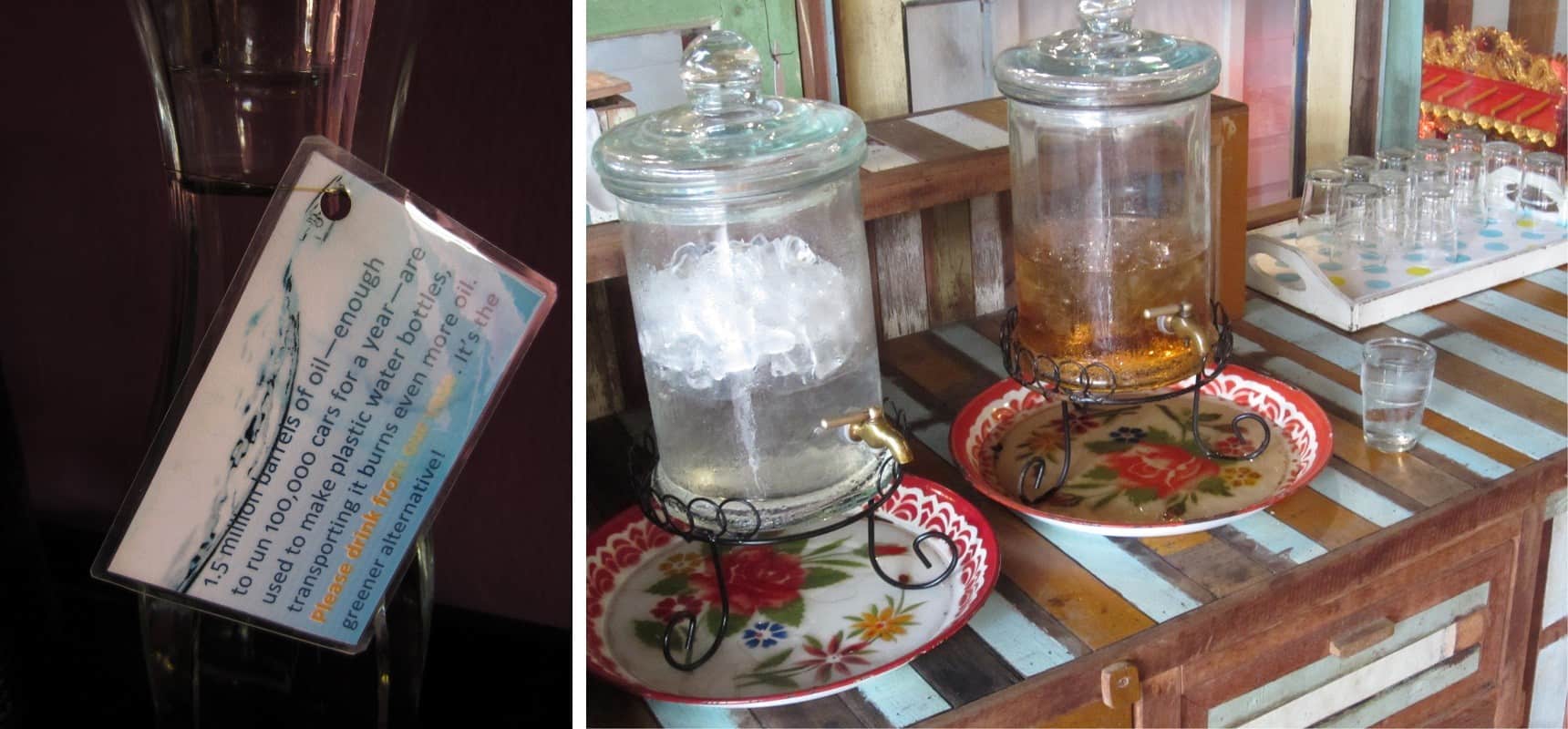
We didn’t have too much planned when we jetted off, but I had booked our first night and last night accommodation in Bangkok, and I’d researched places that appeared to have genuine environmental policies and a focus on sustainability. This paid off: both places offered plastic-free drinking water, and we were able to refill our bottles hassle-free.

waterhotel

Find out what the locals do

Locals don’t drink the tap water, but they don’t all guzzle mineral water from plastic bottles either. So what do they do? In Thailand (at least in the places we visited), companies deliver treated water in big 20 litre drums to households and businesses, and the containers are returned for refilling once they are empty.

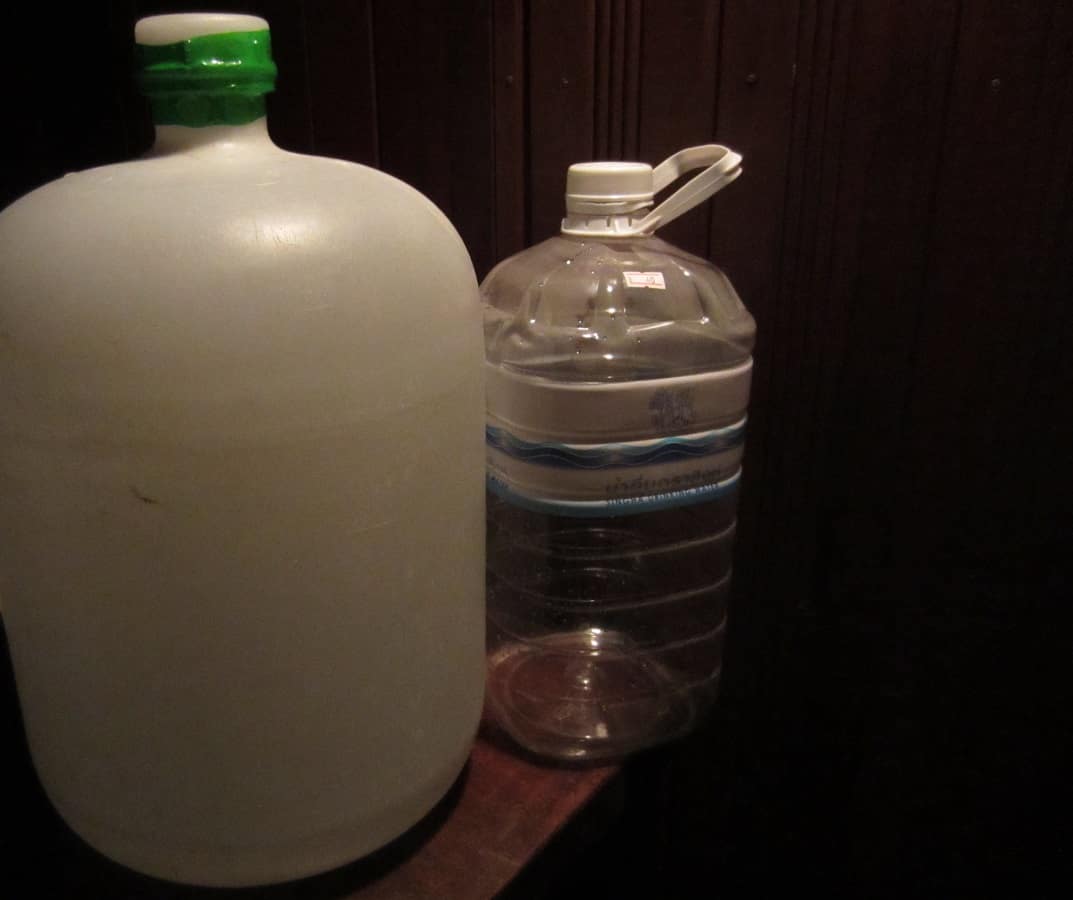
waterrefillsThese containers aren’t marketed to tourists, and the empty containers need returning to the seller, so some retailers were reluctant to part with them. The first place we found would only let us fill up our own containers using their funnel, so we purchased one plastic 6 litre water container and used this for refills. This was our only plastic bottle purchase of the trip! There was no way we would have managed without it, either. We used this to decant the water into our little drinking bottles so we didn’t end up spilling it everywhere.

The second place we needed to use these, we found a seller willing to give us our own bottle by paying a deposit, which we got back once we returned the empty container.

water8

20-litre water drum with the 6-litre water bottle we had to buy. Still, that purchase meant we didn’t have to buy any more plastic bottles on our trip.

Look for alternatives

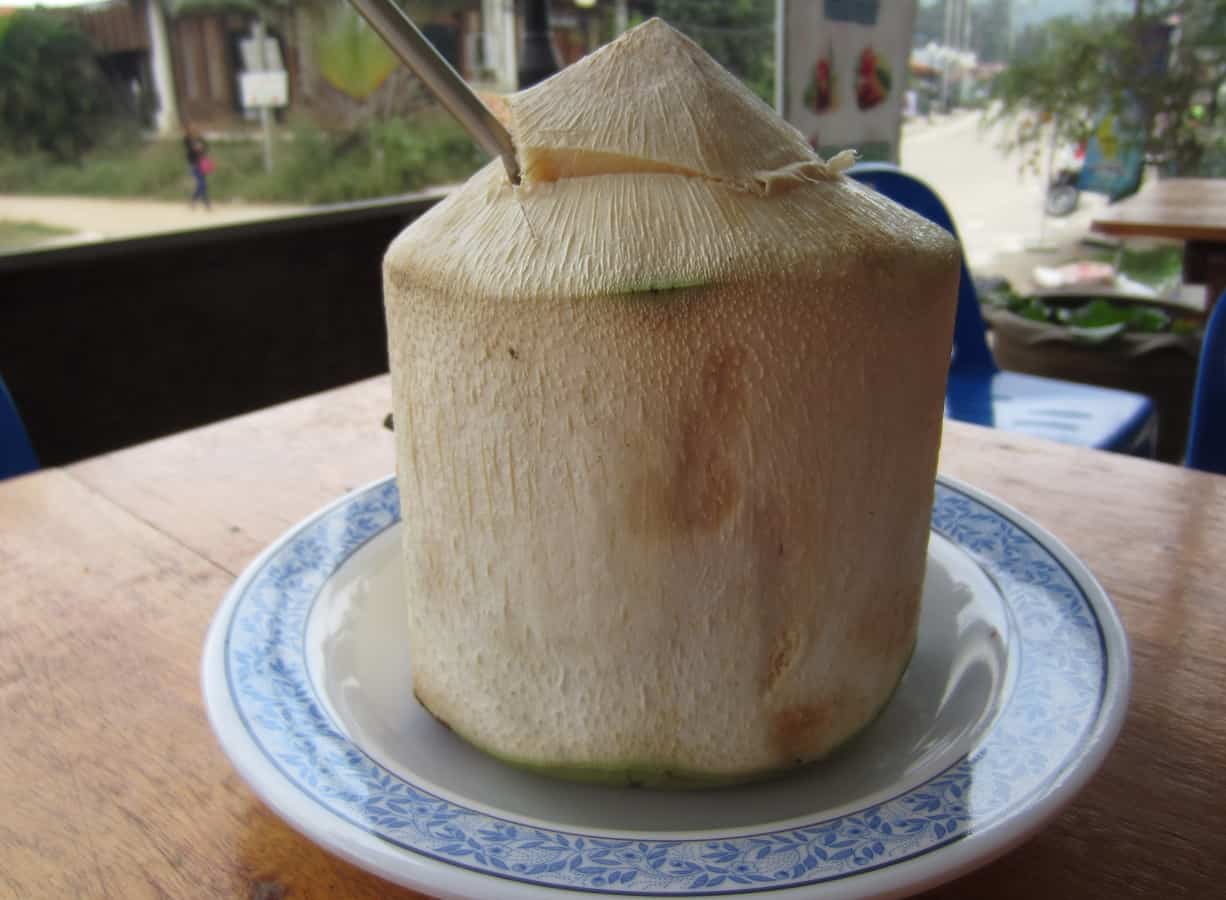
If our water bottles were empty and we were away from our base and unable to refill them, we found we still had options, and there was no need to reach for the plastic. One alternative which comes in completely biodegradable packaging is drinking coconuts. They are very hydrating, refreshing and good for you, and in Thailand, they are available everywhere.

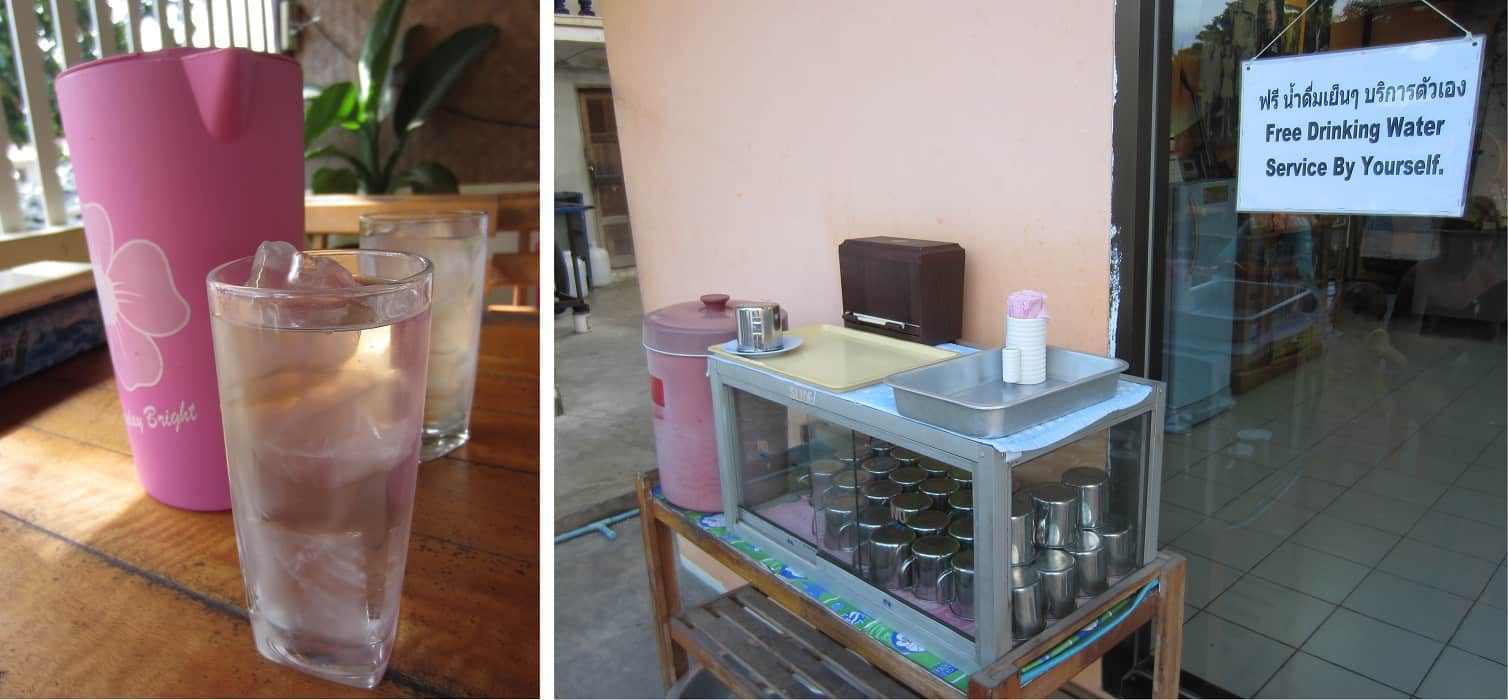
coconutLots of the cheaper Thai restaurants (which catered predominantly for locals rather than tourists) offer drinking water free of charge to patrons. We’d look out for restaurants with this service and try to use them where we could.

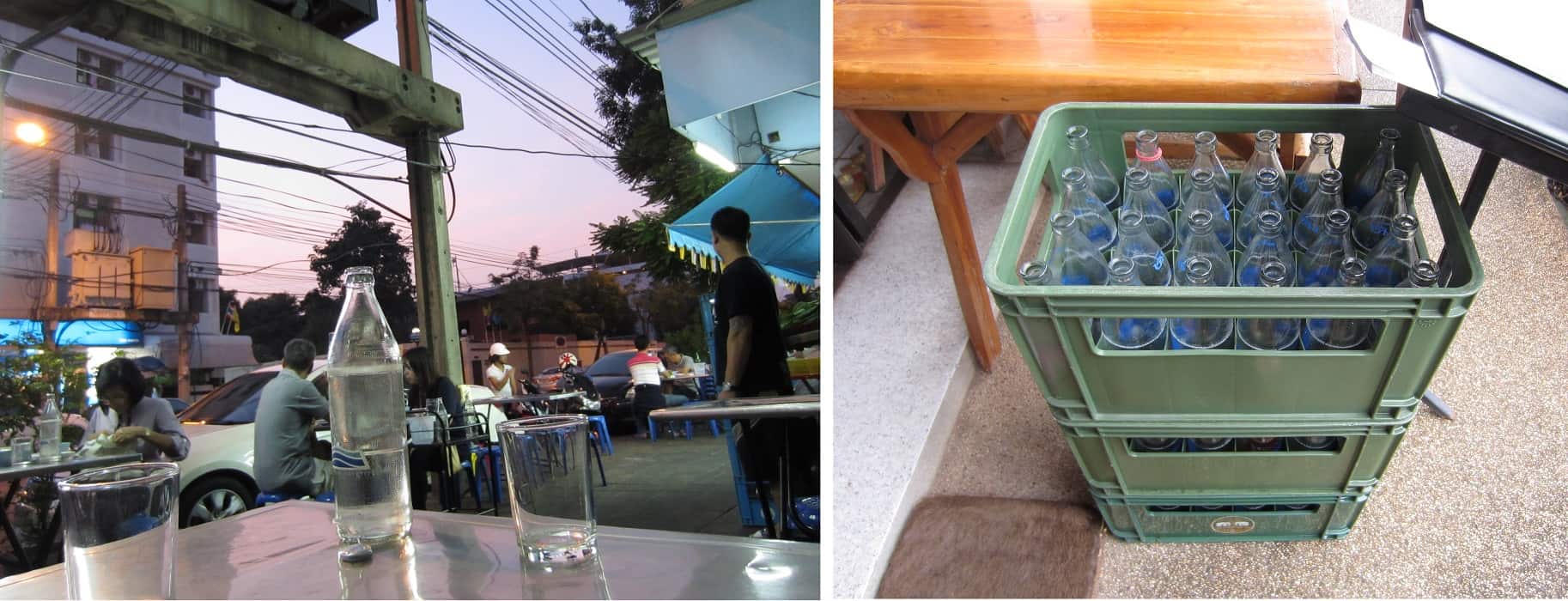
waterfreeWe discovered that a few restaurants sold water in glass bottles that are returned to the manufacturer for refilling. We did talk about buying water at these restaurants to fill up our water bottles if we ran out, but in the end we didn’t need to.

waterglassbottles

We did also see some water vending machines on the streets which filled empty containers. Our only issue was that the instructions were written entirely in Thai and we couldn’t understand how they worked. If we hadn’t found any other alternatives, we’d have popped some coins in the slot to see what happened, but as it turned out, we didn’t need to use these. It’s good to know that alternatives exist, though.

Reap the Rewards

We were completely prepared to pay extra in order to avoid using plastic; we figured it was worth it to limit our impact on the environment. Usually, a higher cost is something that we have to accept for “doing the sustainable thing”. Actually, it ended up being much cheaper! The 20 litre drums of water cost less than a dollar to buy, and many places charged more for a 500ml bottle of water, particularly outside of Bangkok. It was great not to contribute unnecessarily to landfill and keep our plastic-free pledge, and awesome to save money in the process!

Two people, four weeks away, and only one plastic bottle (reused several times before being responsibly recycled). Going plastic-free is just as possible abroad as it is at home if you put your mind to it!

[leadpages_leadbox leadbox_id=1429a0746639c5] [/leadpages_leadbox]
https://treadingmyownpath.com/wp-content/uploads/2014/01/waterhotel-e1389162073718.jpg 800 1720 Lindsay (Treading My Own Path) https://treadingmyownpath.com/wp-content/uploads/2019/06/logo.png Lindsay (Treading My Own Path)2014-01-08 15:58:232017-09-01 14:22:30Going Plastic-Free in Asia: Plastic Water Bottles

Some Recommended Reading

3 Comments/in Living With Less Waste, Minimalism, Musings, Plastic Free Living/by Lindsay (Treading My Own Path)

Yesterday afternoon I dropped my parents off at Perth Airport for their flight back to the UK. They visited for just over four weeks, and it has been insanely busy. Partly because they have been staying in our flat, and my boyfriend and I stayed at his parents’ house, which means I have been making the hour-long commute (one way) between houses each day, and then taking them out to see the sights, before trekking back. This was compounded by us sleeping in a bed that was far too small for us (well mostly my boyfriend, whose ankles stick through the railings meaning it is impossible to move without waking us both up), meaning we have been running on minimal sleep. I had a lovely time, and it was great to be able to spend so much time with them, but now they’ve gone I’ve been hit by a tsunami of exhaustion. I’m tired, emotional and mentally frazzled… which wouldn’t matter so much if everything else in my life wasn’t still going full steam ahead.

This isn’t a blog post about woe is me, though. All I need is sleep, time to unwind, the chance to relax and to eat some nourishing meals and I’ll be ready to go again. I’ve had an awesome month; I’m blessed that my parents were able to come to visit, and for such a substantial amount of time. No complaints here : )

In order to get these things though, I need to prioritize my workload. I was really hoping that I’d be able to keep blogging whilst they visited, but unfortunately I didn’t have the time. Now that they’ve gone, I have a number of looming deadlines to address, and that doesn’t include blogging. I really want to write but I don’t have the time to do justice to the millions of thoughts that are whirring away in my mind. I have still had time to read the posts that others are writing, so I thought that rather than write a rushed, garbled post of my own, I’d share some posts I’ve read over the past month that I have enjoyed. I get so much enjoyment/knowledge/motivation/inspiration/etc from the bloggers that I follow and so I wanted to share in the hope that you might enjoy them too. Far better to share inspiration than write a blog post about not writing a blog post – who wants to read that?!

My recommended reading list

  • EcoGrrl wrote a great post about how conventional beauty and advertising sell women the message that they aren’t good enough in order to shift their chemical-containing products. She’s taken so much time to research this and all women should read it:  Tuesday Go Ponder: Redbook’s Bevy of False Claims, Misleading Ads, and Shaming Women. [NB This link has been removed as it now points to a wrinkle-busting scam, and I can’t find the updated link. If you find it let me know!]
  • Journey to Ithaca shared a great post entitled Thoughts on “Rants”. I probably don’t need to explain what this is about. It begins with the line “I used to be a ranter”, and is thoughtful, well written and definitely has a lesson or two in there!
  • Westywrites is starting preparation for Plastic Free July next year early – 8 months early! She has so much energy and passion for the subject – check out Plastic-Free Me: An Introduction if you’re interested in trying to be more plastic-free (or any of her subsequent posts). Her enthusiasm is infectious!
  • I’ve also been following blog posts by A Girl Called Jack, who blogs about feeding a family for less than £10 but is also a campaigner for Oxfam and Child Poverty Action Group. That description doesn’t actually do her any credit – she’s opened my eyes to all kinds of issues, like foodbanks, benefits, poverty in the UK, how completely immoral the Daily Mail is (and I thought I knew this, but no, turns out they are worse than I could ever have imagined). She’s made me question my own feelings and actions regarding food, poverty and sustainability – in a good way – and I’m still processing all my thoughts.
  • Lastly I wanted to share with you Make it Your Job, a blog post considering why we get resentful and angry. It is the most recent post by Leo Babauta of Zen Habits, a minimalist who embraces simple living. I think every post he writes is super inspiring.

Of course there’s many more amazing blog posts and writers out there who I love, but I don’t want to overload you all! I hope you enjoy some (or all) of these posts. I’m off to get on with my to-do list!

https://treadingmyownpath.com/wp-content/uploads/2019/06/logo.png 0 0 Lindsay (Treading My Own Path) https://treadingmyownpath.com/wp-content/uploads/2019/06/logo.png Lindsay (Treading My Own Path)2013-11-13 14:49:182015-12-14 19:40:26Some Recommended Reading

A Recipe for Coconut Milk Yoghurt (Dairy Free + Plant Based)

20 Comments/in Plastic Free Living, Real Food, Recipes/by Lindsay (Treading My Own Path)

I did something this month that I haven’t done for over a year. I deliberately bought something in a plastic container.

Oh, the scandal!

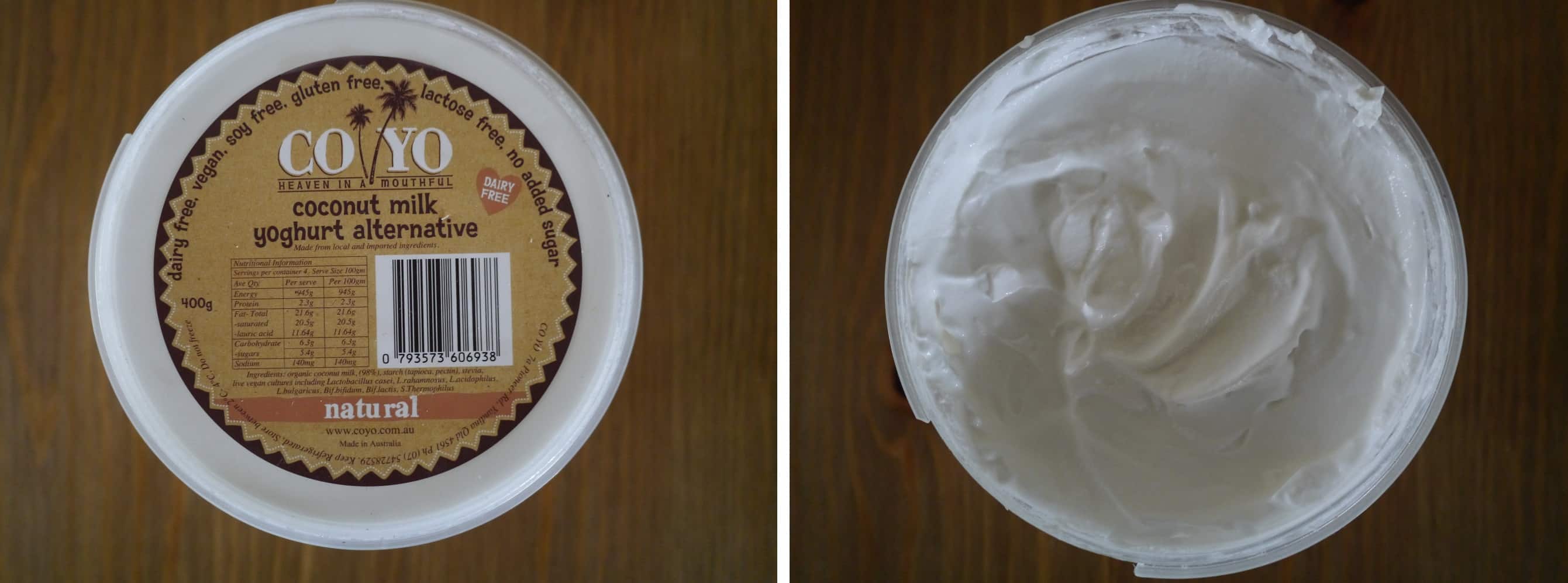
The product in question is a dairy-free yoghurt alternative called CoYo, made from coconut milk and full of probiotic cultures. I’d seen the name pop up in various places and was intrigued. Since being advised to cut out dairy from my diet as much as possible, yoghurt is something I miss, and I particularly believe in the benefits of probiotic foods for maintaining a healthy gut. This product seems like a win-win… apart from the packaging. Of course, I questioned whether I would be able to make it at home. When I saw it in stock in my local health food shop, I was intrigued enough to buy it.

coyo

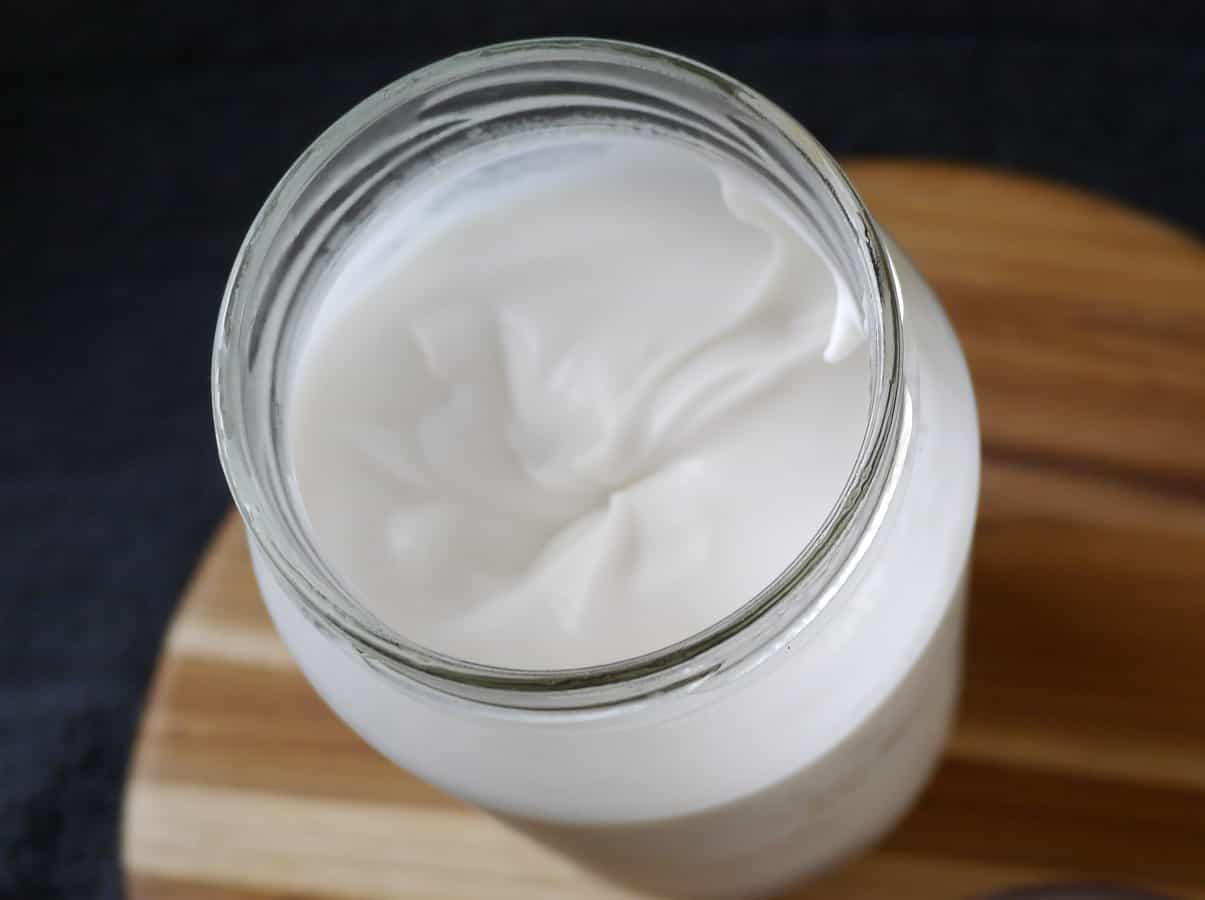
I have to say, CoYo tastes amazing. If I was to describe the flavour, I would say it has the yoghurty-ness of yoghurt, and the coconuty-ness of coconut milk. (Does that make it any clearer?!) I guess what that means is, it has the tangy, slightly acidic taste of yoghurt, but the creamy smooth richness of coconut milk, with that exotic coconut flavour. It is also super smooth and literally melts in my mouth. It is also a stunning bright white colour – like coconut.

It also has a pretty amazing price tag. One small 400g tub cost me over $13! Indeed, I have suffered for my sin.

For reasons of both price and plastic packaging, I can’t justify buying this again. However, now I know how good it is I can try to make my own (and I have a benchmark to measure against), and I can use the CoYo as my starter culture. Its deliciousness has only made my resolve to make my own stronger! I want this in my life!

After a couple of attempts at recreating it, I’m now pretty happy with the recipe I’ve come up with. This recipe makes 1 litre, and should keep in the fridge for 2-3 weeks.

How to Make Coconut Yoghurt

Ingredients:
2 x 400ml tins of organic coconut milk/cream
200ml water (to make up to 1 litre)
8 tbsp arrowroot powder (also called tapioca)
20 drops stevia
1 tbsp CoYo (or other starter culture)

Method:
Blend the arrowroot, coconut milk and water together briefly to remove any lumps.

Heat to above 80ºC for several minutes to allow the mixture to thicken, stirring with a spoon.

Cool to 45ºC.

Add stevia and stir.

Add a spoonful of Coyo to pre-warmed thermos flask. Add a cup of the coconut milk mix to the flask and stir well. Fill the flask halfway and stir again. Add the rest of the mix, stir a final time and seal the lid.

Leave for a minimum of 12 hours but preferably 24 hours.

Pour into a glass jar and store in the fridge.

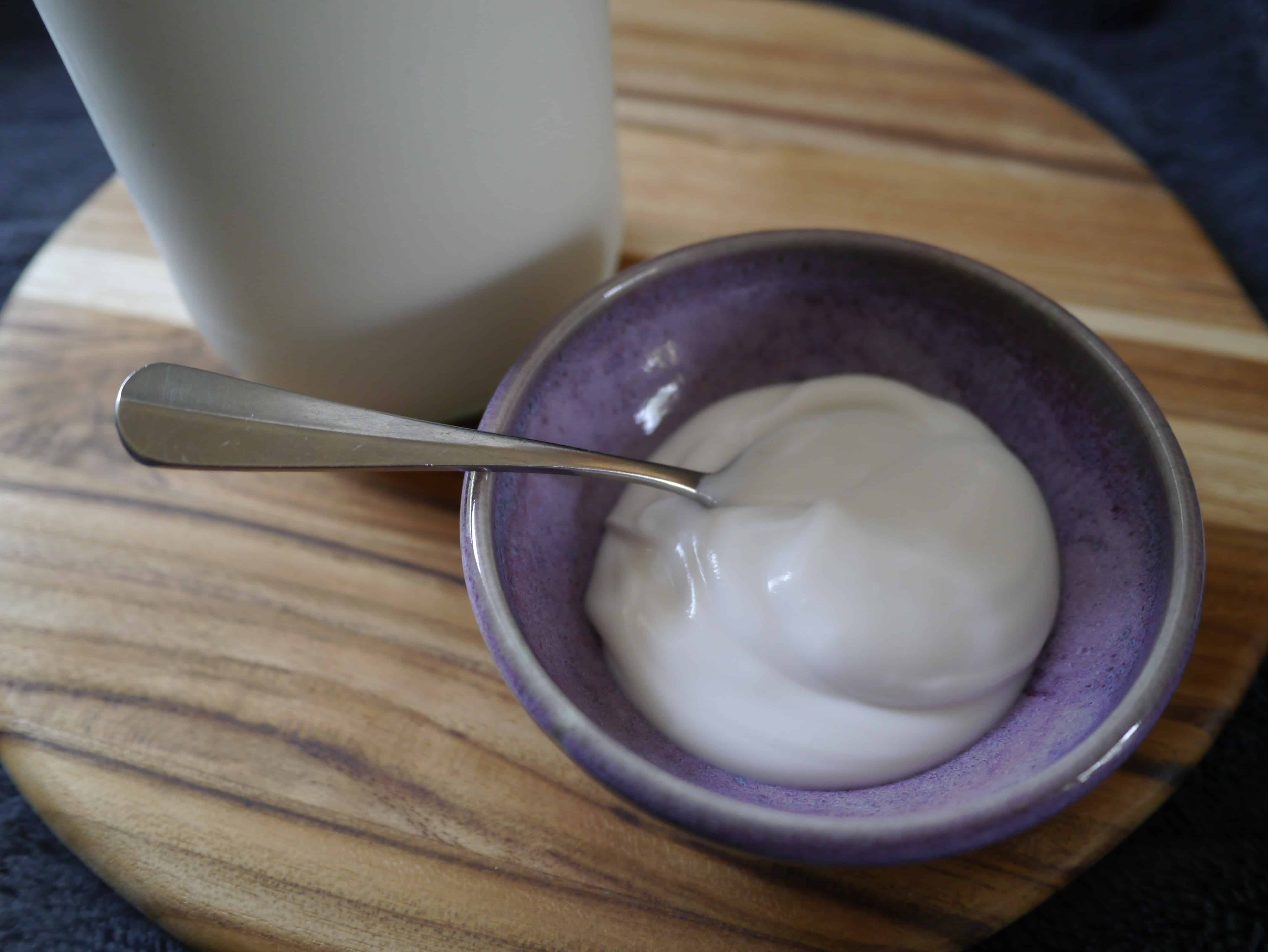
coyo3 coyo2

Notes:

I use Woolworths (Australian) organic coconut cream which comes in a BPA-free tin. It’s one of the few items I still buy at the supermarket and it’s one of the better organic brands that I’ve tried… although I’d love to find a independent brand or make my own in the future.

I used arrowroot and stevia as these were what CoYo lists as its ingredients. It may be possible to use other thickeners. The stevia is to give the friendly bacteria a food source. Other sugars might work too, I just haven’t tried them yet.

I used CoYo as the starter culture as I already had it but if you’re not lactose-intolerant or vegan you could use ordinary live yoghurt. Another option is to use a vegan probiotic capsule.

Coconut yoghurt takes a lot longer to culture than cow’s milk yoghurt. I find that leaving it for 24 hours gets better results.

I have also found that the yoghurt thickens over time, something that doesn’t happen with dairy yoghurt. I don’t know why this happens, but if your yoghurt is a bit thin, you should find it thickens up after a few days.

Obviously, once you’ve made your first batch you can use this as a culture for future batches – no need to keep buying things in plastic containers!

[leadpages_leadbox leadbox_id=1429a0746639c5] [/leadpages_leadbox]
https://treadingmyownpath.com/wp-content/uploads/2013/09/coyo3.jpg 900 1205 Lindsay (Treading My Own Path) https://treadingmyownpath.com/wp-content/uploads/2019/06/logo.png Lindsay (Treading My Own Path)2013-09-23 10:11:492018-12-15 16:40:25A Recipe for Coconut Milk Yoghurt (Dairy Free + Plant Based)
Page 10 of 13«‹89101112›»

Pages

  • 9-tips
  • Birthday book reviews
  • Books
  • Cheatsheets and checklists
  • Every Blog Post I’ve Ever Written
  • Food Waste Challenge
  • Hoarder Minimalist Progress Tracker
  • Instagram
  • Join the mailing list
  • One More Step…
  • Real Food and Recipes
  • Thank you – 3 day food waste challenge
  • Thanks for joining!
  • The Less Waste No Fuss Kitchen Bonus Vault
  • Treading My Own Path Gift Voucher
  • Zero Waste + Plastic Free Living in Perth, Western Australia
  • Home
  • Quotes and facts
  • Resources
  • About
  • Infographics
  • Work with me
  • Minimalism / Simple Living
  • Plastic-free living
  • Upcoming events
  • Zero Waste
  • Explore
  • Blog
  • Less Stuff Book
  • The Less Waste No Fuss Kitchen
  • Thank You
  • Disclaimer & Copyright
  • Privacy Policy

Categories

  • About Me
  • Changemaking
  • Chemical-Free Living
  • Climate action
  • Community
  • Decluttering
  • DIY Skincare
  • Energy
  • environmental guilt
  • Ethical Living
  • Garden
  • growing food
  • Health & Wellness
  • How to…
  • Less Stuff
  • Living With Less Waste
  • Minimalism
  • Money-Saving
  • Musings
  • Out & About
  • Permaculture Gardening
  • Plastic Free July
  • Plastic Free Living
  • Real Food
  • Recipes
  • Simple Living
  • Sustainable Food
  • Thrift
  • Transport
  • Uncategorized
  • urban permaculture
  • Water
  • Zero Waste

Archive

  • November 2022
  • July 2022
  • April 2022
  • March 2022
  • February 2022
  • March 2021
  • February 2021
  • January 2021
  • December 2020
  • November 2020
  • October 2020
  • September 2020
  • August 2020
  • July 2020
  • June 2020
  • May 2020
  • April 2020
  • March 2020
  • February 2020
  • January 2020
  • December 2019
  • November 2019
  • October 2019
  • September 2019
  • August 2019
  • July 2019
  • June 2019
  • May 2019
  • April 2019
  • March 2019
  • February 2019
  • January 2019
  • December 2018
  • November 2018
  • October 2018
  • September 2018
  • August 2018
  • July 2018
  • June 2018
  • April 2018
  • March 2018
  • February 2018
  • January 2018
  • December 2017
  • November 2017
  • October 2017
  • September 2017
  • August 2017
  • July 2017
  • June 2017
  • May 2017
  • April 2017
  • March 2017
  • February 2017
  • January 2017
  • December 2016
  • November 2016
  • October 2016
  • September 2016
  • August 2016
  • July 2016
  • June 2016
  • May 2016
  • April 2016
  • March 2016
  • February 2016
  • January 2016
  • December 2015
  • November 2015
  • October 2015
  • September 2015
  • August 2015
  • July 2015
  • June 2015
  • May 2015
  • April 2015
  • March 2015
  • February 2015
  • January 2015
  • December 2014
  • October 2014
  • September 2014
  • August 2014
  • July 2014
  • June 2014
  • May 2014
  • April 2014
  • March 2014
  • February 2014
  • January 2014
  • December 2013
  • November 2013
  • October 2013
  • September 2013
  • August 2013
  • July 2013
  • June 2013
  • May 2013
  • April 2013
  • March 2013

Treading My Own Path

Privacy / Disclaimer

Sign up to the newsletter

Website by Órla Larkin

Lindsay Miles is an educator, speaker, author and passionate zero waste/plastic-free living advocate helping others live more meaningful lives with less waste and less stuff. She has been sharing ideas, tips, tricks and strategies on her website Treading My Own Path since 2013. Her first book, Less Stuff, was published in 2019 and her second, The Less Waste No Fuss Kitchen was published in June 2020. Originally from the UK, Lindsay now lives in Perth, Western Australia.

Lindsay Miles
© 2024 Lindsay Miles | ABN 84 679 541 090
  • Link to X
  • Link to Youtube
  • Link to Instagram
  • Link to Mail
  • Link to Facebook
Scroll to top Scroll to top Scroll to top

This site uses cookies. Cookies enable me to personalise your experience on this site so I can improve my content and communications.

I'm okay with that

Cookie and Privacy Settings


How we use cookies

We may request cookies to be set on your device. We use cookies to let us know when you visit our websites, how you interact with us, to enrich your user experience, and to customize your relationship with our website.

Click on the different category headings to find out more. You can also change some of your preferences. Note that blocking some types of cookies may impact your experience on our websites and the services we are able to offer.

Essential Website Cookies

These cookies are strictly necessary to provide you with services available through our website and to use some of its features.

Because these cookies are strictly necessary to deliver the website, refusing them will have impact how our site functions. You always can block or delete cookies by changing your browser settings and force blocking all cookies on this website. But this will always prompt you to accept/refuse cookies when revisiting our site.

We fully respect if you want to refuse cookies but to avoid asking you again and again kindly allow us to store a cookie for that. You are free to opt out any time or opt in for other cookies to get a better experience. If you refuse cookies we will remove all set cookies in our domain.

We provide you with a list of stored cookies on your computer in our domain so you can check what we stored. Due to security reasons we are not able to show or modify cookies from other domains. You can check these in your browser security settings.

Other external services

We also use different external services like Google Webfonts, Google Maps, and external Video providers. Since these providers may collect personal data like your IP address we allow you to block them here. Please be aware that this might heavily reduce the functionality and appearance of our site. Changes will take effect once you reload the page.

Google Webfont Settings:

Google Map Settings:

Google reCaptcha Settings:

Vimeo and Youtube video embeds:

Privacy Policy

You can read about our cookies and privacy settings in detail on our Privacy Policy Page.

Privacy Policy
Enough is Enough Free ebook for Subscribers front cover

Join our community and you’ll receive free new content every week and a downloadable eBook “Enough is Enough” to help you take the next steps!

Enough is Enough eBook

Please send me the eBook!

Send my eBook link to:

By downloading the eBook you agree to my Privacy Policy.

I hate spam as much as you do, and I promise to keep your email address safe. I will not share or sell your personal information, ever. You can unsubscribe at any time.

This form collects information I will use to send out the free eBook, new content once a week and an occasional newsletter (with other stuff I think you’ll find useful such as events).

Loading Comments...