• Link to X
  • Link to Youtube
  • Link to Instagram
  • Link to Mail
  • Link to Facebook
Join the community and receive a free EBOOK
Treading My Own Path | Less waste, less stuff, sustainable living
  • ⌂
  • About
  • Work with me
  • Upcoming events
  • Books
    • The Less Waste No Fuss Kitchen
    • Less Stuff
  • Resources
    • Printables
    • Infographics
    • Quotes and facts
  • Explore
    • Minimalism
    • Plastic-free living
    • Real Food and Recipes
    • Zero Waste
  • Blog
  • Click to open the search input field Click to open the search input field Search
  • Menu Menu

I’m passionate about zero waste and sustainable living, just don’t call me this…

25 Comments/in Changemaking, Musings/by Lindsay (Treading My Own Path)

There’s one word I try to use as little as possible when it comes to talking about zero waste, living plastic-free or anything sustainable living related. In fact, I try never to use it at all.

Could you guess what it is?

I’ll tell you, and you might be surprised. Because it’s a word we hear often. Sometimes it’s even prefaced with words like “responsible” or “ethical” or “conscious” – so how could it not be a good word to use, with such honourable descriptors?

The word is this: consumer.

Now, I consume. We all consume. From food and water, to energy, to the things we buy to use and wear and own, we are consuming.

But calling myself a consumer? That implies that the main thing of value I have to offer is my ability to use up resources.

Being first and foremost a consumer means declaring that our best and most valued traits are our shopping habits.

And that is not the case at all.

I just don’t… I just can’t… identify with being a consumer above all else.

When was it decided that we would be reduced simply to consumers, to cogs in the economy, our value judged by what and how and how much we buy?

I try to never label myself (or anyone else) a consumer, and I don’t want to be labelled a consumer. I don’t really want to be called a responsible consumer, an ethical consumer or a conscious consumer, for that matter.

Yes, I try to consume responsibly, ethically and consciously. But I don’t identify as someone who buys stuff. I feel that labelling someone a consumer takes away their power, and says – the only way that you have influence is by shopping.

We have power. To share ideas, to express our opinions, to call out companies, to make our voices heard, to apply pressure to businesses and governments, to vote, to demand change, and to ask for things to be different.

Our power extends far beyond the things we buy.

Let’s not give our power away.

So if we don’t call ourselves consumers, what do we call ourselves instead?

The way I see it: we are community members. We are citizens. We are people (both as individuals and groups) who care a great deal about the planet and our children’s future.

But somehow this label of ‘consumer’ has got pushed to the forefront and rather than saying “I’m a concerned and passionate citizen” we are reducing ourselves to just one part of the whole: a ‘conscious consumer’.

I am so much more than that, you are so much more than that; we are so much more than that.

Now I’m sure we’ve all heard the saying “money talks” and the idea that “we can vote with our dollars for the change we want to see”. And I do believe that this is true: we can vote with our dollars.

But voting with our dollars does not have to mean shopping, or buying, or even consuming.

It can mean choosing green energy, or opting for public transport, or donating money to charitable causes, or contributing to organizations whose work we admire.

In fact, sometimes we “vote with our dollars” when we don’t buy anything at all.

I vote with my dollars when I opt out of the formal economy and swap stuff, share stuff, and make do with what I have.

And yes, I vote with my dollars when I shop at the local bulk store, or buy something from the charity shop.

Very occasionally I’m voting with my dollars when I buy something brand-spanking-new from a store, or less frequently, that has to get shipped from interstate.

Because yes, I consume. I try to consume responsibly, and ethically, and consciously. (And minimally yes, but I do still consume.)

That does not reduce me to a consumer.

Did you see the Guardian article published earlier in May which stated that it had updated its style guide to reflect more accurately the environmental crises facing the world?

So “climate change” is now “climate emergency” or “climate breakdown”, and “global warming” is now “global heating”. The editor-in-chief of the Guardian was quoted as saying that they wanted to ensure that they are being scientifically precise, and communicating clearly.

“The phrase ‘climate change’”, she said, “sounds rather passive and gentle when what scientists are talking about is a catastrophe for humanity.”

The words we use to describe things are important. Stronger language definitely invokes stronger reactions. Climate breakdown clearly has a sense of urgency that climate change does not.

And ‘concerned citizen’ has a power and gravitas to it that ‘responsible consumer’ does not.

Plus, it’s far more accurate.

We cannot make the world a better place simply by consuming better. We have a chance, we have a choice and we have, I think, a responsibility to do more than simply buy things to try to create positive change.

Let’s share ideas. Let’s share resources. Let’s champion those that do good, and hold those that do not to account. Let’s sign petitions, let’s add our voice to campaigns for change, lets write to our politicians and governments. Let’s get involved where we can, and put our energy into things that matter.

Let’s consume consciously. But let’s not give our power away and reduce ourselves to being consumers, first and foremost. That is not who we are, and that is not the limit of what we can do.

The truth is, we will never save the world by shopping.

Now I’d love to hear from you! Do you agree, disagree, did you learn something new, have you changed your mind or are you sticking with the status quo? Whatever your thoughts are I’d love to hear them so be sure to leave a comment below!

https://treadingmyownpath.com/wp-content/uploads/2019/05/Ethical-Consumer-Zero-Waste-Living-Plastic-Free-Sustainable-Living-Treading-My-Own-Path.jpg 750 1000 Lindsay (Treading My Own Path) https://treadingmyownpath.com/wp-content/uploads/2019/06/logo.png Lindsay (Treading My Own Path)2019-05-23 15:55:282021-11-04 17:04:56I’m passionate about zero waste and sustainable living, just don’t call me this…

How To Begin a Zero Waste/Plastic Free Facebook Group

9 Comments/in Changemaking, Zero Waste/by Lindsay (Treading My Own Path)

Back in April 2016, I set up a Perth Zero Waste + Plastic Free Facebook Group. I wanted to create a space where local people could get information, ask questions, receive feedback and “meet” other people in our area. My website focuses a lot on zero waste and plastic-free living: the what, the why, and to some extent, the how – but not the finer details.

I always felt that this was missing and needed talking about somewhere, but I didn’t know where, or how to manage it. This kind of information changes quickly, and it is a lot for one person to keep on top of.

Eventually it occurred to me that Facebook Groups could be the answer.

Last week, the Perth Zero Waste + Plastic Free group hit 5,000 members. 5000! I am so proud and humbled that our community has that many people who care about their waste, and that they have all been able to connect with one another thanks to this group. The ideas shared and friendships made has been so inspiring.

I’m a huge fan of connecting offline, and there’s nothing like attending a workshop or talk or group activity to really get into the spirit. But there’s definitely a space for online groups. We don’t all have the time or energy to get out into the community, and besides – if you just want to know where to buy plastic-free tofu, that isn’t really a workshop kind of question!

I think when they work together – people meeting online and then connecting offline – that’s magical.

Our group has been really successful, and has far exceeded my expectations – not jut in terms of numbers, but also the kinds of information available and also the types of people who have joined. It’s a really diverse group, too. I talked about zero waste privilege a few weeks ago, and this group definitely debunks the white, middle-class female myth about zero waste living.

I definitely think it’s the members who have made the community what it is. But I also think the success has been due to the vision and the planning, and the way it is administrated.

Love or hate Facebook, there’s a lot of people using it. More than one billion people, in fact. Whilst we can all lament the fake news, and the fact we spend far more time looking at cat videos than we ever intend to, Facebook is a useful tool. Facebook groups in particular, have been a great way to connect with like-minded people. (At the time of writing this, Facebook Groups are still free from ads – another reason I like them.)

I thought I’d put together a guide for how I set up and how I run our Facebook group, what’s worked well and what I’ve learned. Whether you’re thinking of setting up your own group, or have a group that you’d like to improve, hopefully you’ll be able to draw from my experiences.
Setting Up a Zero Waste Facebook Group – Before You Begin

Consider Who The Group Is For, and What You Want It To Achieve

Think about your audience, the types of people you’d like to attract as members, and the types of people you think that you can serve best. What is your area of expertise, and who will benefit from joining a group that covers this?

Think also about how many members would make a good group. More isn’t necessarily better. Do you want a smaller, more connected group who you can get to know and maybe transition to an offline group? Do you want to keep things very local (just to your suburb), or to your town, or region/county/state? Is it for certain language speakers? Do you want the broad depth of knowledge that comes from a worldwide group?

Is your group just for women, or men; young mums, retirees, or students; low income earners, the unemployed or professionals? Beginners or experts?

There’s no right or wrong answer, but it helps to think about this in advance. Things evolve over time, but if you have a clear idea who the group is for, it will keep the information offered specific and relevant.

Try to think deeper than just “everybody”! Whilst “everybody” sounds inclusive, the more general you are, the less helpful you will actually be to your members.

For my group, it was specifically people who live in Perth who wanted to learn more about reducing their waste. They can be experts or beginners, but the information shared in the group has to be relevant to living zero waste and plastic free in the Perth area.

Why? Because I felt that this information was in my head and needed to be shared, and my website wasn’t the place. I knew people in Perth would want to know the specifics that other blog readers would not.

I also remember when I first took part in Plastic Free July back in 2012, the Facebook page was very small. Because Plastic Free July began in Perth, it was easy to get local information there. Fast forward a few years and there are now 30,000 followers on the Plastic Free July page. There is no way you’d find out which local grocers sell milk in glass.

I felt people new to Plastic Free July were missing out on something useful that I had experienced.

Check The “Competition”

I don’t really believe in competition. When we’re all working towards a common cause, it isn’t a competition, is it? What I really mean is “duplication”. There is absolutely no point in exactly recreating something that already exists. See what exists, and ask yourself – how will your group be different?

This doesn’t mean that if someone is doing something similar, that there isn’t space for you. Competition can mean there is high demand! Think about how many cookbooks there are on Italian cookery, or even something as specific as pasta – heaps.

However, duplication is wasted energy. There will be a different take or a different spin that you can offer. Be clear what it is.

Consider Who Else Can Join When You Launch

Tempting as it can be to open up the group to everyone, if you’re clear about who your audience is and who you want to participate, be careful about letting others who do not fit those categories in. Whilst it could be fine, you might dilute the message and usefulness of the group for other members.

One thing that I should have done differently was be much stricter about who could join the Perth group. The group is for people in Perth to talk about Perth things, but when I launched the group, I opened it up to members worldwide. I think I worried about getting enough members to make the conversations interesting and provide value. Honestly, when I set it up, I hoped to reach about 500 members. The group hit 500 members and kept on growing, and I realised if I didn’t change who could join, we’d end up with a generic audience with less relevance.

Firstly I limited the audience to Australia, and then Western Australia. Now anyone wanting to join has to let us know where they live in Perth or WA to be considered as a member. There are still some inter-state and international members who joined before we changed the terms (we didn’t delete anyone!), but they know that the conversation is Perth-centric.

Prepare the “Rules”

I wrote a couple of documents outlining what the group is about, who can join and how we expect members to behave. Our group is friendly and supportive, it doesn’t matter where you are in the journey and no question is a stupid question.

When new members join, they are expected to read this post. Whilst not everyone does, it is helpful to refer back to when conversations stray from the topics. It’s also useful to assess if a post or member doesn’t meet the standards we expect, and needs removing.

Running A Zero Waste Facebook Group – The Early Days

Finding New Members

I started with the people I knew, people who were already Facebook friends. I’m lucky that I have a lot of friends passionate about this topic! I probably started the group with 80 or so personal friends.

When I give talks, I always mention the Facebook group at the end as a next step for people to join. (I actually mention this rather than my website.) After every talk I give, a new flush of members comes in. As the audience grows, friends of friends request to join, and so it has grown organically.

Finding Admins

Unless you’re on Facebook all the time, you’ll likely need admins to help you approve new members, answer questions and delete spam. I asked a good friend and my husband to help admin the group (my husband uses Facebook much more than I do).

At the start, I checked in every day, often twice a day (once in the morning and once in the evening). As the group has grown, I’ve found I need to do this less often as there are plenty of knowledgeable people in the group to answer questions and share expertise.

Running A Zero Waste Facebook Group – Maintenance

Moderating a Growing Audience

As the audience grows, so does the number of admins required. I didn’t react to this quickly enough at the start, and there were a couple of times when huge fights broke out and then blew up in between the times I checked. When someone called it out as the admins “allowing this to happen” I realised it was too big for me to manage.

Once a group has been running for a while, it’s easy to spot the people who post often, are helpful, polite, and have interesting insights. I asked a few of these people (I chose people I’d also met in real life, although this isn’t necessary) to join as moderators. I really wish I’d done this sooner – it was a huge weight off my shoulders and it stopped any crazy conversations getting out of hand.

Occasionally I post to remind people about the values of the group (being nice to beginners, answering the question asked rather than telling the asker what they are doing wrong, not posting blatant advertising or Amazon affiliate links) but it doesn’t happen that often. Other members who are not moderators know how the group works, and are quick to jump in and remind people if a conversation begins to go off track.

Moderating the Conversation

Not every single post is 100% useful or 100% relevant, but we try to delete as little as possible. By sticking to the guidelines (no salesy posts or affiliate links, relevant to Perth, and relevant to zero waste and plastic free living) it’s pretty easy to decide whether something should stay or go. Posts about tiny houses in Oregon or India banning styrofoam might be really interesting, but they don’t fit the description of what our group is about, and ultimately they detract from the message.

Now we have 5000 members, we have to keep things stricter. We have a lot of posts per day, and we don’t want members feeling like the feed has become a bunch of memes. Happily, I think it’s worked.

…

Overall, I love what our group has become. It feels like a positive, inspiring and motivating space to spend time. (That isn’t something I thought I’d say about social media.) That’s not to say it’s perfect, and there are occasional disagreements and fiery exchanges, but overall the support offered and received is wonderful. It’s one of the best things I ever did to support zero waste living in my community.

If you’ve been wondering how you can get the zero waste or plastic free message out into your community, maybe it’s something you can do too.

Now I’d love to hear from you! Do you use Facebook Groups for connecting to your community (doesn’t have to be zero waste related) and what benefits have you found? Have you had a good experience, or a bad experience? Had it been mixed? Any other thoughts about Facebook groups you’d like to add? Leave a comment below!

[leadpages_leadbox leadbox_id=1429a0746639c5] [/leadpages_leadbox]
https://treadingmyownpath.com/wp-content/uploads/2017/10/How-to-Start-a-Plastic-Free-Zero-Waste-Facebook-Group-Online-Community.jpg 750 1000 Lindsay (Treading My Own Path) https://treadingmyownpath.com/wp-content/uploads/2019/06/logo.png Lindsay (Treading My Own Path)2017-10-12 13:17:522019-03-09 19:24:59How To Begin a Zero Waste/Plastic Free Facebook Group

Getting Stuff Done (A Kind Guide for the Time Poor)

11 Comments/in Changemaking/by Lindsay (Treading My Own Path)

Almost all of us would like to do more than we currently have time for. I’m somebody who gets a lot of stuff done, but there are still far more things I’d love to do than there are hours in the day. Plus I don’t have children, relatives I have to care for, long commutes or other things taking up my time before I get to do the things I’m passionate about.

Often, lack of time is a reason why we don’t embrace the changes we’d like to make. Changing habits and learning new skills doesn’t happen overnight.

But are we really time-poor? Or do we just think we are?

Being Time-Poor: What Does it Mean and What Can We Do About it?

Time-poor means not having time to do everything we’d like to do, or not having spare time. Clearly, we all have the same 24 hours in the day, but I’m not going to tell you that just because you have the same 24 hours in the day as Beyonce, you should be achieving your dreams. Let’s get real here. I’m pretty sure she can pay a nanny, and a cleaner, and a PA.

The way I see it, the way we spend our time can be divided into three:

Things that we have to do.

Things that we feel we should do.

Things that we do because we want to do them, and because we enjoy them.

Then there’s the long list of things we’d like to do, if only we had the time.

The question is, is it possible to change this? And more importantly, do we want to?

One technique I find very helpful for deciding if I’m prioritising my time well, is to divide a piece of paper into two columns, and on one side write down all the things that I love to do, want to do, and that make me happy.

Then, in the other side I write down how I actually spend my time.

I look at the two columns, and see how much similarity there is. If the two columns don’t match, I start to look at what I’m currently doing that I could maybe change, in order to make time for things that I do want to do.

The Things We Feel We Should Do

The easiest ones to look at are those things that come under the “feel like I should do” category. These aren’t things we actually need to do, but maybe feel obliged to do, or have continued to do even though the passion has gone.

Can we actually say no, or turn some things down, in order to create space?

Can we seek help from someone else to do these things in order to free up time?

The Things We Need To Do

These are the non-negotiables, like eating, working and sleeping. Whilst they might be necessities, that doesn’t mean there isn’t room to tweak things.

Can we batch cook meals and then freeze them to save time? Can we take the train or bus to work rather than driving, so that we have time to read? Can we actually get up when the alarm goes off rather than dozing for another 45 minutes?

Even small tweaks can free up a little time here or there, and it all adds up.

Appreciating Timeframes

In most cases, we can’t just make changes tomorrow. Maybe we realise that reducing our commute will free up time, but we need to find a new job closer to home before we can make the change. Maybe we realise that when our toddler goes to school we will have plenty more time, but we’re still two year away from this change.

It doesn’t matter, but it can be helpful to recognise that time isn’t static. If we’re frustrated now, we can appreciate that things won’t always be like this. Being ready for the change and doing what we can to make it happen sooner (if possible) might be all we can do for now.

Can We Make Time?

Making time can come down to whether we really want to do something, and are willing to put in the hard work, or whether we like the idea of something.

There’s nothing wrong with the latter. I love the idea of learning plenty of things, but I know I don’t have the motivation to pursue most of them…at least, not now. But I like storing these little dreams in my imagination, just in case the time ever comes. If not, it doesn’t matter. The possibility is enough. 

Think in Terms of Projects

When we feel time poor but really want to make changes, we can look at the change we want to make as a ‘project’. A project is something with a defined outcome and a defined timeframe. We can split it down into what we want to achieve, and how much time we think we need.

We can decide for a month, we will set the alarm two hours earlier. Or we can decide we will: give up TV for a month, switch off social media after 6pm, neglect the non-urgent housework, get takeaway two times a week to free up the evenings, get a babysitter.

These might not be sustainable, long-term solutions, but when we have a clear timeframe, we can make them work.

Particularly with learning new habits, it is the learning that takes time. Once they are ingrained and we don’t need to think about them, they take up much less energy.

Try Not To Get Distracted with ‘Busy’ Tasks

Nobody is too busy to tell you how busy they are. But is busy the same as productive?

Imagine an empty bathtub, and now imagine it filled with watermelons. It’s full, right?

Now imagine emptying a big sack of walnuts over the top of the bath. All those round walnuts fill in the spaces around the watermelons. They don’t come up over the sides. Now the bath is full.

Finally, imagine emptying another sack of poppy seeds over the bath, and all those poppy seeds make their way into the crevices and cracks between the watermelons and the walnuts. Now the bath is definitely full.

We can think of those watermelons, walnuts and poppy seeds as the tasks we fill our day with, and the bathtub as the day. Those watermelons are the projects, or the big tasks we want to work on. The reality is, we need to set time aside for these bigger tasks, or the smaller tasks (the walnuts and the poppy seeds) will fill up the whole day.

We can feel ‘busy’ when we occupy ourselves with small tasks, particularly the repetitive ones that constantly need doing. We can feel good about it too. Finishing small tasks gives us a sensory reward and a morale boost. But it often doesn’t get us any closer to achieving our big goals. Instead they suck our time.

Truth is, small tasks are small, and they are easy to fit in around other things. We will never tackle our big tasks unless we make time for them.

(That’s not to say we can’t make our big projects more manageable by breaking them down into small tasks, if they are small, one-off tasks towards a defined goal.)

Try Not To Compare Yourself With Others

We are all different. We all have different energy levels, and we all draw energy from different things. Some of us love our jobs and feel reinvigorated when we work. Some of us hate our jobs and feel like sitting on the couch for three hours afterwards. Some of us love our jobs, but find then emotionally or physically draining.

Some of us can do tasks quickly, and some of us are painfully slow. Some of us are fast learners, and others are not. Some of us have great memories, and some of us have to be reminded a billion times before it sinks in.

It often surprises people when I tell them that I can’t write quickly. But you’re a writer! Yes, but I can’t just churn out blog post after blog post. I like to take my time and craft my words, and think deeply about what I’m saying. I have massive respect for those people who write multiple articles every single day. That will never be me. (Oh, another home truth. I can’t even touch type!)

Just because someone else can do things in a certain way, or a particular time frame, that doesn’t mean we all can. Besides, often we don’t know the whole story. We don’t know how much support they have behind the scenes, or how much training they have in an area.

We also don’t know how much of a priority this is to them. It might not be such a priority to us.

See other people’s successes and triumphs as what they are – good things worth celebrating. They have nothing to do with you, and what you can achieve has nothing to do with them. Don’t let their achievements rob you of your own. Go at your own pace, and if you want to, you will get there.

I’d love to hear from you – what sucks your time? What would you love to do with a few extra hours in the day? How do you manage to get the important things done? Or what keeps you from getting them done? Any other tips you’ve found useful? Anything else to add? Please share your thoughts in the comments below!

[leadpages_leadbox leadbox_id=1429a0746639c5] [/leadpages_leadbox]

https://treadingmyownpath.com/wp-content/uploads/2017/04/Getting-Stuff-Done-Kind-Guide-Time-Poor-Changing-Habits-Treading-My-Own-Path.jpg 750 1000 Lindsay (Treading My Own Path) https://treadingmyownpath.com/wp-content/uploads/2019/06/logo.png Lindsay (Treading My Own Path)2017-04-06 12:00:242017-08-01 21:47:34Getting Stuff Done (A Kind Guide for the Time Poor)

The Magic of Making Ripples

10 Comments/in Changemaking, Plastic Free Living, Zero Waste/by Lindsay (Treading My Own Path)

Even the smallest actions can have bigger impacts than we realise. It’s true. When I first came across the challenge of giving up plastic for a month back in 2012 (I’m talking about Plastic Free July) I had no idea just how much this decision would change my life. I had no idea that a world of new discoveries, challenges and opportunities was about to open up before me.

After all, at the time it seemed that all I was signing up for was refusing a few plastic bags and avoiding single-use plastic-packaged groceries!

Plastic Free July changed everything for me. It challenged many things that I’d just accepted to be true, and behaviours I’d simply accepted as the way that things were done. It changed the way I saw the world. It changed the way I saw the problems in the world. It made me realise that change began with me.

It made me act. I slowly cut plastic out of my life, and in doing so I discovered a thriving local community, made many new connections with like-minded people, improved my health, began supporting local businesses and really started living a life that was in line with my values – and felt much happier for it, too!

Plastic Free July ignited a passion in me that has never gone out. The first six months were very much a personal journey, but as new habits formed and the challenges of living plastic-free lessened, this energy and enthusiasm has transferred to something bigger. Now I’m trying to educate and inspire others to think about their own personal environmental impact, and live more sustainable lifestyles, through writing, public speaking and running workshops.

I’ve been running one of these workshops (focusing on sustainable living) over the last six weeks, and last week was the final session. It’s been a great few weeks with a group of inspiring and enthusiastic people, and so rewarding!

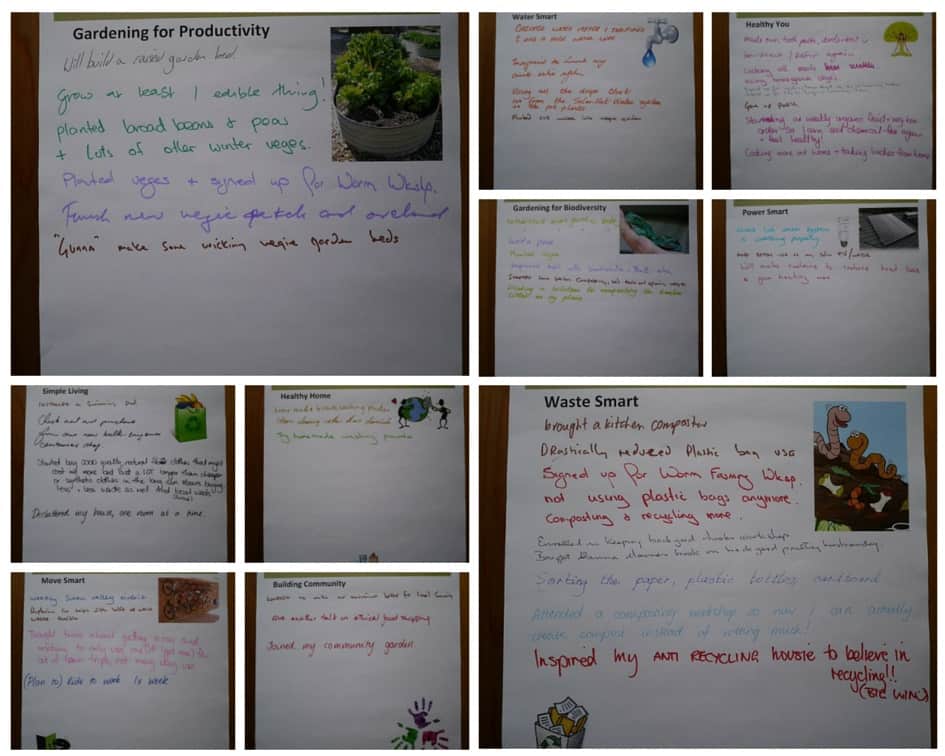
At the end of the course I asked the participants to share all the changes they’ve made so far, or are planning to change soon. Here’s what they wrote:

Living Smart Goals

This is the kind of response that makes it all worthwhile! People feeling inspired to make positive changes, and taking action!

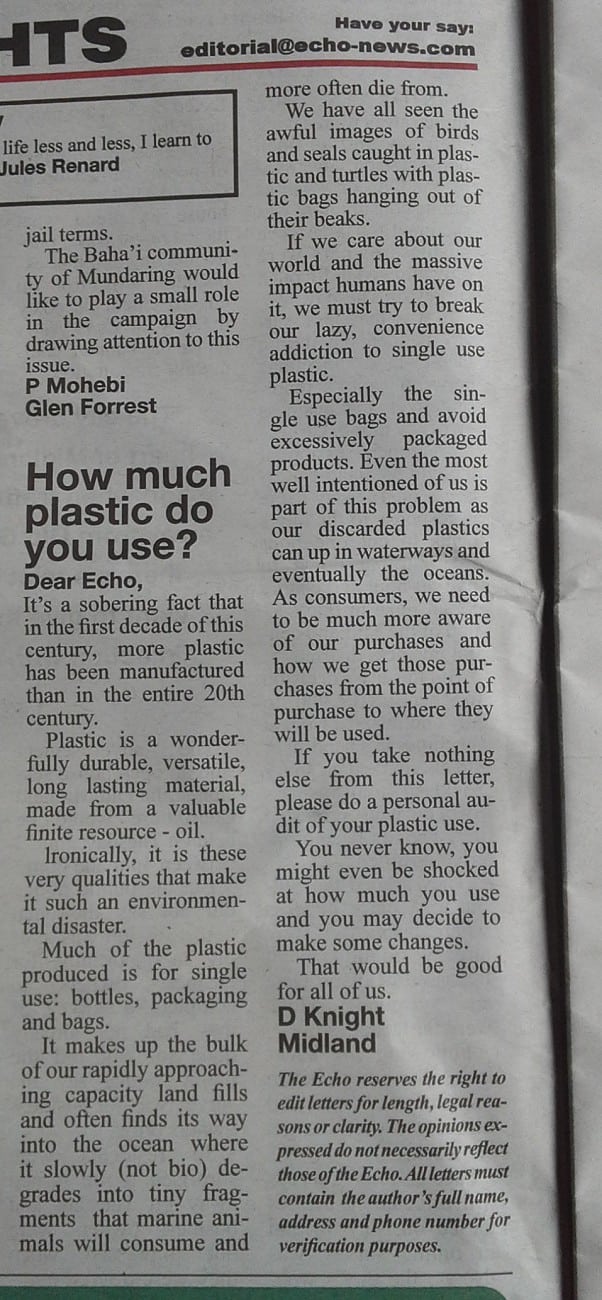
In addition, just after the course ended one of my participants sent me an email… “just a quick email to let you know we really enjoyed the course and we have made some positive changes because of it. I have also attached a photo of a letter that got published by our local rag, the Midland Echo. Its not one of my best but l think it makes the point… If someone replies to it, we can keep the theme rolling for a few weeks and perhaps broaden the debate out.”

Here’s the letter:

Dave Knight Letter to Echo Plastic

When I signed up to Plastic Free July in 2012, I had no idea that as individuals, we really do have the power to make a difference. That is where my real inspiration has come. It’s so rewarding to work with people and support them in making changes to their lives, and to witness the satisfaction that comes with these achievements.

Reading these lists filled me with gratitude that I’ve been able to share a message that is important to me, and that the people I’ve shared it with have been inspired to take that message and make it their own.

I realised something else from looking at these lists. Thinking about it on a personal level, in some way, small or otherwise, I have influenced all of those behaviours. To have that kind of influence is a powerful thing.  But of course, we all have that kind of influence. We usually don’t get to see lists of all the things that we influenced, but nevertheless, everything we do has some kind of influence on someone else.  Everything we do has an impact beyond ourselves, even if we don’t always realise.

Our actions are like ripples, that extend out and reach others in ways we don’t always know or see.

Whether it’s the conversations we have with friends or at the checkout when asked if we need a plastic bag, whether it’s the blog posts or articles we write that others read, whether it’s the way we behave when we pick up litter or choose to use a reusable container in public… There are others around us who are observing, watching, listening, and thinking.

It may be the people we know, or it may be the people we simply have a chance encounter with. The things we choose to do, or say, will have an influence on others. Know that whatever you do, you have the power to make a difference.

[leadpages_leadbox leadbox_id=1429a0746639c5] [/leadpages_leadbox]
https://treadingmyownpath.com/wp-content/uploads/2015/06/Ripples-Changemaking-Treading-My-Own-Path.jpg 709 1000 Lindsay (Treading My Own Path) https://treadingmyownpath.com/wp-content/uploads/2019/06/logo.png Lindsay (Treading My Own Path)2015-06-09 12:00:202017-03-11 10:44:06The Magic of Making Ripples

Pages

  • 9-tips
  • Birthday book reviews
  • Books
  • Cheatsheets and checklists
  • Every Blog Post I’ve Ever Written
  • Food Waste Challenge
  • Hoarder Minimalist Progress Tracker
  • Instagram
  • Join the mailing list
  • One More Step…
  • Real Food and Recipes
  • Thank you – 3 day food waste challenge
  • Thanks for joining!
  • The Less Waste No Fuss Kitchen Bonus Vault
  • Treading My Own Path Gift Voucher
  • Zero Waste + Plastic Free Living in Perth, Western Australia
  • Home
  • Quotes and facts
  • Resources
  • About
  • Infographics
  • Work with me
  • Minimalism / Simple Living
  • Plastic-free living
  • Upcoming events
  • Zero Waste
  • Explore
  • Blog
  • Less Stuff Book
  • The Less Waste No Fuss Kitchen
  • Thank You
  • Disclaimer & Copyright
  • Privacy Policy

Categories

  • About Me
  • Changemaking
  • Chemical-Free Living
  • Climate action
  • Community
  • Decluttering
  • DIY Skincare
  • Energy
  • environmental guilt
  • Ethical Living
  • Garden
  • growing food
  • Health & Wellness
  • How to…
  • Less Stuff
  • Living With Less Waste
  • Minimalism
  • Money-Saving
  • Musings
  • Out & About
  • Permaculture Gardening
  • Plastic Free July
  • Plastic Free Living
  • Real Food
  • Recipes
  • Simple Living
  • Sustainable Food
  • Thrift
  • Transport
  • Uncategorized
  • urban permaculture
  • Water
  • Zero Waste

Archive

  • November 2022
  • July 2022
  • April 2022
  • March 2022
  • February 2022
  • March 2021
  • February 2021
  • January 2021
  • December 2020
  • November 2020
  • October 2020
  • September 2020
  • August 2020
  • July 2020
  • June 2020
  • May 2020
  • April 2020
  • March 2020
  • February 2020
  • January 2020
  • December 2019
  • November 2019
  • October 2019
  • September 2019
  • August 2019
  • July 2019
  • June 2019
  • May 2019
  • April 2019
  • March 2019
  • February 2019
  • January 2019
  • December 2018
  • November 2018
  • October 2018
  • September 2018
  • August 2018
  • July 2018
  • June 2018
  • April 2018
  • March 2018
  • February 2018
  • January 2018
  • December 2017
  • November 2017
  • October 2017
  • September 2017
  • August 2017
  • July 2017
  • June 2017
  • May 2017
  • April 2017
  • March 2017
  • February 2017
  • January 2017
  • December 2016
  • November 2016
  • October 2016
  • September 2016
  • August 2016
  • July 2016
  • June 2016
  • May 2016
  • April 2016
  • March 2016
  • February 2016
  • January 2016
  • December 2015
  • November 2015
  • October 2015
  • September 2015
  • August 2015
  • July 2015
  • June 2015
  • May 2015
  • April 2015
  • March 2015
  • February 2015
  • January 2015
  • December 2014
  • October 2014
  • September 2014
  • August 2014
  • July 2014
  • June 2014
  • May 2014
  • April 2014
  • March 2014
  • February 2014
  • January 2014
  • December 2013
  • November 2013
  • October 2013
  • September 2013
  • August 2013
  • July 2013
  • June 2013
  • May 2013
  • April 2013
  • March 2013

Treading My Own Path

Privacy / Disclaimer

Sign up to the newsletter

Website by Órla Larkin

Lindsay Miles is an educator, speaker, author and passionate zero waste/plastic-free living advocate helping others live more meaningful lives with less waste and less stuff. She has been sharing ideas, tips, tricks and strategies on her website Treading My Own Path since 2013. Her first book, Less Stuff, was published in 2019 and her second, The Less Waste No Fuss Kitchen was published in June 2020. Originally from the UK, Lindsay now lives in Perth, Western Australia.

Lindsay Miles
© 2024 Lindsay Miles | ABN 84 679 541 090
  • Link to X
  • Link to Youtube
  • Link to Instagram
  • Link to Mail
  • Link to Facebook
Scroll to top Scroll to top Scroll to top

This site uses cookies. Cookies enable me to personalise your experience on this site so I can improve my content and communications.

I'm okay with that

Cookie and Privacy Settings


How we use cookies

We may request cookies to be set on your device. We use cookies to let us know when you visit our websites, how you interact with us, to enrich your user experience, and to customize your relationship with our website.

Click on the different category headings to find out more. You can also change some of your preferences. Note that blocking some types of cookies may impact your experience on our websites and the services we are able to offer.

Essential Website Cookies

These cookies are strictly necessary to provide you with services available through our website and to use some of its features.

Because these cookies are strictly necessary to deliver the website, refusing them will have impact how our site functions. You always can block or delete cookies by changing your browser settings and force blocking all cookies on this website. But this will always prompt you to accept/refuse cookies when revisiting our site.

We fully respect if you want to refuse cookies but to avoid asking you again and again kindly allow us to store a cookie for that. You are free to opt out any time or opt in for other cookies to get a better experience. If you refuse cookies we will remove all set cookies in our domain.

We provide you with a list of stored cookies on your computer in our domain so you can check what we stored. Due to security reasons we are not able to show or modify cookies from other domains. You can check these in your browser security settings.

Other external services

We also use different external services like Google Webfonts, Google Maps, and external Video providers. Since these providers may collect personal data like your IP address we allow you to block them here. Please be aware that this might heavily reduce the functionality and appearance of our site. Changes will take effect once you reload the page.

Google Webfont Settings:

Google Map Settings:

Google reCaptcha Settings:

Vimeo and Youtube video embeds:

Privacy Policy

You can read about our cookies and privacy settings in detail on our Privacy Policy Page.

Privacy Policy
Enough is Enough Free ebook for Subscribers front cover

Join our community and you’ll receive free new content every week and a downloadable eBook “Enough is Enough” to help you take the next steps!

Enough is Enough eBook

Please send me the eBook!

Send my eBook link to:

By downloading the eBook you agree to my Privacy Policy.

I hate spam as much as you do, and I promise to keep your email address safe. I will not share or sell your personal information, ever. You can unsubscribe at any time.

This form collects information I will use to send out the free eBook, new content once a week and an occasional newsletter (with other stuff I think you’ll find useful such as events).

Loading Comments...